The phrase “thank you so much” is one of the most common expressions of gratitude in modern English, but many learners still ask: is it correct to say thank you so much? The answer is yes.
It is grammatically correct, natural, and widely used by native English speakers in everyday conversations, professional communication, and personal messages.
However, correctness is only one part of choosing the right expression. The phrase carries a particular emotional tone: it sounds warmer and more appreciative than a simple “thank you.”
In some situations, it is perfect because it shows genuine gratitude. In others, a shorter or more formal expression may be more suitable.
This guide explains what “thank you so much” means, why it is grammatically correct, how natural it sounds, when to use it, when to avoid it, and what alternatives work best in different situations.
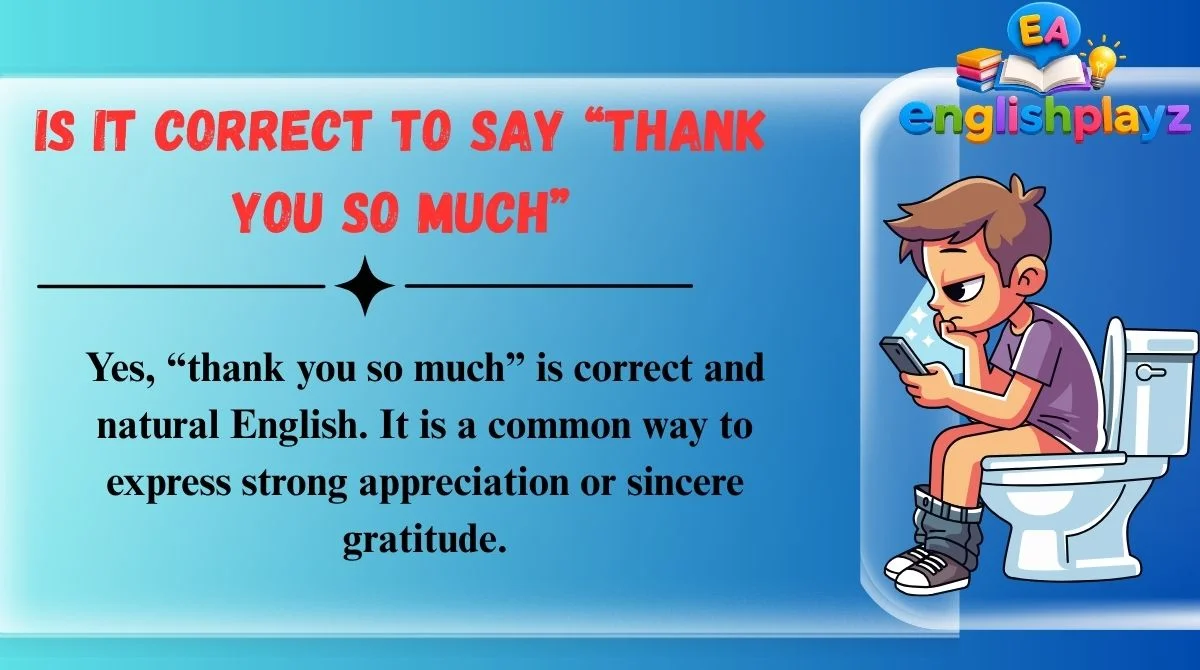
Is It Correct to Say “Thank You So Much”?
Yes, “thank you so much” is correct and natural English. It is a common way to express strong appreciation or sincere gratitude. The phrase is polite, warm, and widely accepted in American, British, Canadian, and Australian English. It can be used in both spoken and written communication, although the level of warmth it conveys depends on the context.
What Does “Thank You So Much” Mean?
“Thank you so much” means “I am very grateful” or “I sincerely appreciate what you have done.” The word “so” intensifies the phrase, making the speaker’s gratitude sound stronger than a simple “thank you.”
Compare these examples:
- “Thank you for your help.”
- “Thank you so much for your help.”
Both sentences are correct, but the second one suggests deeper appreciation. It may communicate that the help was especially valuable, unexpected, or meaningful.
The phrase does not literally mean that the speaker is thanking someone “a large amount.” In English, “so much” functions as an intensifier, adding emotional emphasis.
Examples:
- “Thank you so much for driving me home.”
- “Thank you so much for taking the time to explain this.”
- “Thank you so much for your thoughtful gift.”
In each case, the speaker is emphasizing sincere gratitude.
Why Is “Thank You So Much” Grammatically Correct?
The grammar of “thank you so much” is straightforward.
The expression contains:
- Thank — a verb expressing gratitude
- You — the person receiving the gratitude
- So much — an intensifying phrase showing a high degree of appreciation
Originally, “thank you” comes from the verb “to thank.” The speaker is essentially saying, “I thank you.” Over time, “thank you” became a fixed expression used independently.
The addition of “so much” strengthens the emotion:
- “Thank you” = appreciation
- “Thank you very much” = stronger appreciation
- “Thank you so much” = strong, often warmer appreciation
All three are grammatically acceptable.
A common mistake is assuming that “so much” sounds incorrect because it is informal. In reality, it is perfectly normal English. The phrase appears frequently in conversations, emails, customer service messages, speeches, and professional interactions.
How Natural Does “Thank You So Much” Sound to Native Speakers?
Native speakers generally consider “thank you so much” a very natural phrase. It is probably one of the most frequently used ways to express gratitude in English.
It works especially well when the speaker wants to sound:
- Appreciative
- Friendly
- Warm
- Sincere
- Emotionally engaged
For example:
Natural:
Thank you so much for helping me prepare for the presentation. I really appreciate your support.
This sounds friendly and genuine.
However, the phrase’s naturalness depends on the relationship between speakers and the situation.
In a casual conversation:
“Thank you so much for bringing coffee!”
sounds completely normal.
In a highly formal legal or corporate document:
“Thank you so much for your cooperation.”
may sound slightly more personal than necessary. A more neutral option might be:
“Thank you for your cooperation.”
The phrase is not wrong in formal settings, but the extra warmth may or may not match the desired tone.
Is “Thank You So Much” Formal, Informal, or Professional?
“Thank you so much” is polite and versatile, but it is generally warmer and more personal than highly formal expressions.
Its tone can be described as:
| Context | Suitability | Tone |
|---|---|---|
| Conversation with friends | Excellent | Warm and friendly |
| Customer service | Excellent | Appreciative and polite |
| Workplace emails | Usually appropriate | Professional but personable |
| Academic communication | Appropriate in many cases | Respectful |
| Very formal business writing | Sometimes less ideal | Slightly informal |
For example, an employee writing to a colleague might say:
Thank you so much for reviewing my report before the meeting.
This sounds professional while still showing appreciation.
However, a formal announcement might use:
Thank you for your continued support.
The best choice depends on the relationship and purpose of the message.
When Should You Use “Thank You So Much”?
“Thank you so much” is especially appropriate when someone has made an effort, provided help, offered kindness, or done something meaningful.
Everyday situations
Examples:
Thank you so much for picking me up from the airport.
Thank you so much for remembering my birthday.
Thank you so much for your advice.
Workplace situations
Examples:
Thank you so much for your quick response. It helped me complete the project on time.
Thank you so much for organizing the meeting and preparing the materials.
Email communication
Examples:
Thank you so much for sending the documents. I appreciate your assistance.
Thank you so much for your feedback. I will make the requested changes today.
Personal messages
Examples:
Thank you so much for being there when I needed support.
Thank you so much for the wonderful gift. It means a lot to me.
The phrase is particularly useful when you want your gratitude to feel heartfelt rather than routine.
When Might “Thank You So Much” Sound Awkward?
Although the phrase is correct, it is not always the best choice. The issue is usually not grammar but tone.
1. When the situation requires extreme formality
In official or highly formal communication, “thank you so much” may feel slightly conversational.
Less suitable:
Thank you so much for your official confirmation of the agreement.
More suitable:
Thank you for your confirmation of the agreement.
2. When the gratitude is minor or automatic
Sometimes “so much” may sound excessive if the action was very small.
For example:
Thank you so much for passing me the pen.
This is not incorrect, but it may sound overly enthusiastic unless there is a special reason.
A simple:
Thank you.
may be more natural.
3. When used repeatedly
If someone writes “thank you so much” many times in the same message, it can lose its impact.
Example:
Thank you so much for your email. Thank you so much for your help. Thank you so much for your time.
A more natural version:
Thank you so much for your email, your help, and your time.
How to Use “Thank You So Much” in Professional Emails
Many people wonder whether “thank you so much” is professional. The answer is yes, when used appropriately.
It works well in emails because modern professional communication often values friendliness and appreciation.
Good examples:
Thank you so much for your assistance with this project. Your input was extremely helpful.
Thank you so much for arranging the interview. I appreciate the opportunity.
Thank you so much for your patience while we resolved the issue.
However, avoid using it in every email closing. A professional message may sound more balanced with alternatives such as:
Thank you for your consideration.
Thank you for your continued support.
I appreciate your time and assistance.
The key difference is that “thank you so much” emphasizes personal warmth, while some alternatives emphasize professionalism and neutrality.
“Thank You So Much” vs. Similar Expressions
Different gratitude expressions communicate slightly different levels of emotion and formality.
| Expression | Meaning and Tone | Best Use |
|---|---|---|
| Thank you | Simple appreciation | Everyday situations |
| Thank you very much | Stronger and slightly more formal | Professional or polite situations |
| Thank you so much | Warm and sincere appreciation | Personal and professional communication |
| Thanks a lot | Casual gratitude, sometimes ambiguous | Informal conversations |
| I really appreciate it | Personal and sincere | Workplace and personal messages |
| I’m very grateful | More emotional or formal | Serious expressions of thanks |
“Thank you so much” vs. “Thank you very much”
Both are correct. The difference is mainly tone.
“Thank you very much” can sound slightly more formal or traditional.
Example:
Thank you very much for your assistance.
“Thank you so much” often sounds more personal:
Thank you so much for helping me through this difficult time.
“Thank you so much” vs. “Thanks a lot”
“Thanks a lot” can be friendly, but depending on tone, it may sometimes sound sarcastic.
Example:
Thanks a lot for leaving the door open.
This could mean genuine thanks or annoyance.
“Thank you so much” is less likely to be misunderstood.
Common Mistakes When Using “Thank You So Much”
Although the phrase is simple, learners sometimes make mistakes with spelling, punctuation, or usage.
Mistake 1: Writing “thankyou”
Incorrect:
Thankyou so much for your help.
Correct:
Thank you so much for your help.
“Thank you” is written as two separate words.
Mistake 2: Adding unnecessary words
Incorrect:
Thank you so much very much for your help.
Correct:
Thank you so much for your help.
Do not combine multiple intensifiers.
Mistake 3: Using it when “thank you” is enough
Incorrect in some contexts:
Thank you so much for moving your chair slightly.
This is grammatically fine but may sound exaggerated.
Better:
Thank you for moving your chair.
Mistake 4: Confusing “thank you” and “thanks”
“Thank you so much” is more complete and polite than “thanks so much,” although both can be correct.
Examples:
- Professional email: “Thank you so much for your assistance.”
- Friendly text: “Thanks so much for helping me!”
Regional Differences in Using “Thank You So Much”
There are no major differences in meaning between American, British, Canadian, and Australian English. Speakers in all these regions commonly use “thank you so much.”
Some slight differences may exist in preferred style.
American English often uses:
Thank you so much for your help!
British English may sometimes prefer:
Thank you very much for your help.
However, both expressions are completely natural in both varieties.
Canadian and Australian speakers also commonly use both forms. The choice usually depends more on personality, relationship, and situation than geography.
Better Alternatives to “Thank You So Much” for Different Situations
Sometimes another phrase communicates your meaning more effectively.
For formal business communication
Use:
Thank you for your consideration.
This is suitable for applications, requests, and official communication.
Example:
Thank you for your consideration. I look forward to hearing from you.
For professional appreciation
Use:
I really appreciate your help.
This sounds sincere while remaining workplace-appropriate.
Example:
I really appreciate your help with preparing the presentation.
For deep gratitude
Use:
I’m extremely grateful.
This expresses stronger emotion.
Example:
I’m extremely grateful for everything you have done for my family.
For casual communication
Use:
Thanks so much.
This is a relaxed version of “thank you so much.”
Example:
Thanks so much for picking me up!
Choosing the right phrase depends on whether you want to sound formal, friendly, emotional, or neutral.
FAQs
Is “thank you so much” grammatically correct?
Yes, “thank you so much” is grammatically correct. The phrase combines the expression “thank you” with “so much,” which intensifies the level of gratitude. It is standard modern English and is commonly used by native speakers.
Can you say “thank you so much” in a professional email?
Yes, you can use “thank you so much” in professional emails when you want to sound appreciative and friendly. It is especially suitable when someone has provided help, feedback, time, or support. For highly formal messages, a simpler “thank you” may be more appropriate.
Is “thank you so much” better than “thank you very much”?
Neither phrase is always better. “Thank you so much” often sounds warmer and more personal, while “thank you very much” can sound slightly more formal. Both are correct and natural.
Is “thanks so much” the same as “thank you so much”?
They have the same basic meaning, but “thanks so much” is slightly more casual. “Thank you so much” is more versatile and works better in professional situations.
Does “thank you so much” sound too emotional?
Not usually. The phrase expresses strong appreciation but is normal in everyday English. It may sound overly enthusiastic only when the situation is very minor or when the phrase is repeated too often.
What is another way to say “thank you so much”?
Alternatives include “I really appreciate it,” “I’m very grateful,” “thank you very much,” and “I sincerely appreciate your help.” The best choice depends on the level of formality and emotion you want to express.
Final Thoughts
Yes, it is correct to say thank you so much. The phrase is grammatically accurate, natural, and widely used across English-speaking countries.
It communicates sincere appreciation and is appropriate for many everyday, personal, and professional situations.
The main consideration is not correctness but tone. “Thank you so much” sounds warmer and more personal than a simple “thank you,” making it ideal when you want to show genuine gratitude.
In extremely formal settings, a more neutral expression may sometimes fit better.
For most conversations and messages, however, “thank you so much” is a polite, natural, and effective way to express appreciation. Choose it when you want your gratitude to feel sincere, friendly, and meaningful.

I am Sayan Roy, an English language enthusiast dedicated to helping readers understand word meanings, vocabulary, grammar, and useful English expressions through clear, simple, and informative content.