The phrase “in my opinion” is one of the most common expressions English speakers use when they want to introduce a personal view. If you are wondering, “is it correct to say in my opinion,” the answer is yes.
It is grammatically correct, natural, and widely used in modern English. However, like many expressions, its effectiveness depends on the situation, tone, and audience.
“In my opinion” clearly signals that what follows is a personal belief rather than an absolute fact.
It is appropriate in conversations, essays, emails, meetings, and discussions. However, using it too often can make writing sound repetitive, and in some contexts, a different phrase may sound smoother or more confident.
This article explains what “in my opinion” means, why it is correct, how native speakers use it, whether it sounds professional, when to avoid it, and what alternatives may work better in different situations.
Is It Correct to Say “In My Opinion”?
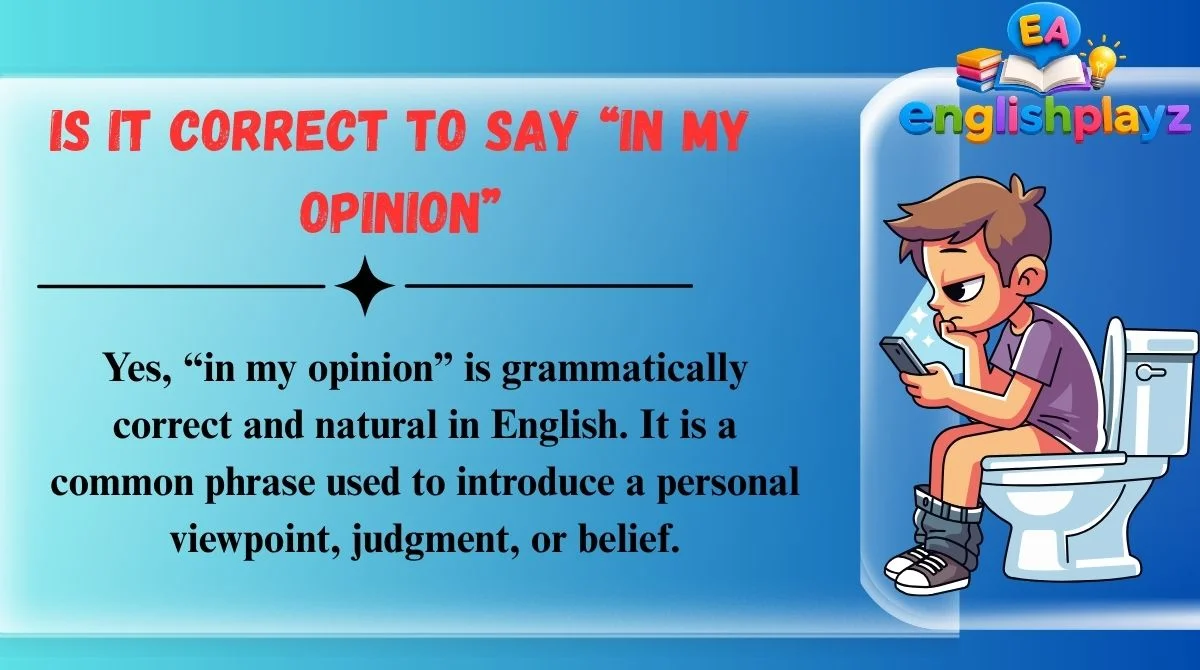
Yes, “in my opinion” is grammatically correct and natural in English. It is a common phrase used to introduce a personal viewpoint, judgment, or belief. The expression is neutral in tone and can be used in both spoken and written English.
“In my opinion” means “according to my personal view” or “based on what I think.” It tells listeners or readers that the statement represents your perspective rather than a proven fact.
For example:
In my opinion, this restaurant offers the best Italian food in the city.
The speaker is not claiming this is universally true. They are simply sharing their personal judgment.
The phrase is especially common in discussions, academic writing, reviews, workplace conversations, and everyday communication. It is neither incorrect nor outdated. However, the surrounding sentence determines whether it sounds natural, overly cautious, or unnecessary.
What Does “In My Opinion” Mean in English?
The expression “in my opinion” is a phrase used to introduce a personal belief, evaluation, or interpretation. It allows speakers and writers to separate their own perspective from objective information.
The word “opinion” refers to a personal idea or judgment that may differ from someone else’s view. The words “in my” show that the opinion belongs to the speaker or writer.
Compare these examples:
- The movie was released in 2025.
- In my opinion, the movie was one of the best releases of the year.
The first sentence presents a fact. The second presents a personal evaluation.
People commonly use “in my opinion” when:
- giving advice
- discussing preferences
- explaining viewpoints
- disagreeing politely
- writing reviews
- participating in debates
Examples:
- In my opinion, learning a language requires regular practice rather than occasional study.
- In my opinion, the second proposal is more practical because it costs less.
- In my opinion, honesty is one of the most important qualities in a leader.
The phrase does not make a statement weaker. Instead, it accurately shows that the speaker is expressing a personal perspective.
Why Is “In My Opinion” Grammatically Correct?
The grammar of “in my opinion” follows a standard English structure. It is a prepositional phrase that functions as an introductory phrase, telling the reader or listener the source of the viewpoint.
The structure is:
in + possessive adjective + noun
Examples:
- in my opinion
- in your opinion
- in his opinion
- in her opinion
- in their opinion
The phrase is usually followed by a comma when it appears at the beginning of a sentence.
Correct:
In my opinion, this solution will save time.
Incorrect:
In my opinion this solution will save time.
The comma helps separate the introductory phrase from the main sentence.
The phrase can also appear later in a sentence:
This solution will save time, in my opinion.
Both versions are grammatically acceptable. The position changes the emphasis slightly. Beginning with “in my opinion” highlights that the statement is personal. Ending with it can sound more conversational.
Does “In My Opinion” Sound Natural to Native English Speakers?
Yes, native English speakers commonly use “in my opinion.” It sounds natural, especially when someone wants to clearly express a personal view.
However, natural speech does not always require this phrase. Native speakers often choose shorter alternatives depending on the situation.
For example:
In my opinion, we should leave earlier.
This is perfectly natural. In casual conversation, a speaker might simply say:
I think we should leave earlier.
Both sentences are correct, but “I think” often sounds more relaxed and conversational.
“In my opinion” may sound slightly more deliberate because it clearly marks a viewpoint. This can be useful when discussing topics where people may disagree.
Examples:
In my opinion, remote work has improved productivity for many employees.
I think remote work has improved productivity for many employees.
The first sounds more like a formal discussion. The second sounds more like everyday conversation.
The phrase becomes less natural when repeated too frequently.
Less effective:
In my opinion, this book is interesting. In my opinion, the characters are realistic. In my opinion, the ending is meaningful.
Better:
In my opinion, this book is interesting. The characters are realistic, and I especially like the meaningful ending.
Is “In My Opinion” Formal, Polite, or Professional?
“In my opinion” is considered neutral. It can be formal, polite, or professional depending on the context.
It works well in:
- business meetings
- workplace emails
- academic discussions
- presentations
- written reports
Example in a professional setting:
In my opinion, we should review the customer feedback before making a final decision.
This sounds respectful because it presents a recommendation without forcing the idea on others.
The phrase can also make disagreement more polite.
Compare:
Direct:
Your plan will not work.
More diplomatic:
In my opinion, your plan may need some adjustments before implementation.
The second version acknowledges that it is only one perspective.
However, in some professional situations, stronger wording may be better.
For example, a manager giving a clear instruction may not need:
In my opinion, employees should submit reports by Friday.
A clearer version:
Employees should submit reports by Friday.
The best choice depends on whether you are sharing a suggestion or communicating a decision.
How to Use “In My Opinion” in Conversations and Emails
In everyday conversations, “in my opinion” is useful when you want to make your viewpoint clear. It often appears during discussions about preferences, choices, or controversial topics.
Examples:
In my opinion, summer is the best season because there are more outdoor activities.
In my opinion, that was the right decision.
In my opinion, people should spend less time checking their phones.
In emails, the phrase can help maintain a respectful tone.
Example:
In my opinion, the revised schedule will work better for the team because it gives everyone more preparation time.
It is also useful when giving feedback:
In my opinion, the introduction could be improved by making the main argument clearer.
However, professional emails often benefit from variety. Instead of repeating “in my opinion,” writers can use alternatives such as “I believe,” “I suggest,” or “from my perspective.”
Example:
I believe the new approach will improve efficiency.
This often sounds confident while still showing that it is a viewpoint.
When Should You Avoid Using “In My Opinion”?
Although “in my opinion” is correct, there are situations where it may not be the best choice.
1. When the information is a fact
Do not use “in my opinion” before a fact.
Awkward:
In my opinion, Paris is the capital of France.
The capital of France is a factual matter, not a personal belief.
Better:
Paris is the capital of France.
2. When you want a stronger professional statement
Sometimes “in my opinion” can make a confident recommendation sound uncertain.
Less effective:
In my opinion, this strategy will increase sales.
Stronger:
This strategy is likely to increase sales based on the available data.
3. When you are stating an obvious personal preference
In casual speech, adding the phrase may feel unnecessary.
For example:
In my opinion, I like chocolate ice cream.
A more natural sentence:
I like chocolate ice cream.
The phrase is most useful when there is room for disagreement or interpretation.
Examples of Correct and Incorrect Uses of “In My Opinion”
Understanding examples helps show how the phrase works in real communication.
Correct and natural examples
- In my opinion, this is the most effective way to solve the problem.
- In my opinion, the company should focus more on customer service.
- In my opinion, that restaurant has improved significantly.
- In my opinion, studying vocabulary in context is more helpful than memorizing lists.
- In my opinion, the meeting would be more productive if everyone prepared in advance.
- The book was well written, in my opinion.
- In my opinion, she handled the situation professionally.
Grammatically correct but less natural examples
- In my opinion, I personally think this movie is great.
The phrase “in my opinion” already shows personal belief, so “I personally think” is repetitive.
Better:
In my opinion, this movie is great.
Incorrect or unsuitable examples
- In my opinion, water freezes at zero degrees Celsius.
This is a fact, not an opinion.
- In my opinion, please send the document today.
A request does not normally need an opinion marker.
Better:
Please send the document today.
Better Alternatives to “In My Opinion” and Their Differences
Although “in my opinion” is correct, other expressions may fit certain situations better.
| Expression | Tone | Best Use |
|---|---|---|
| I think | Casual and natural | Everyday conversations |
| I believe | Professional and confident | Work, presentations, formal writing |
| From my perspective | Thoughtful and analytical | Discussions and reports |
| In my view | Similar to “in my opinion” but slightly formal | Essays and discussions |
| Personally, I think | Personal and conversational | Friendly conversations |
“I think”
“I think” is probably the most common everyday alternative.
Example:
I think we should wait until tomorrow.
It sounds natural and friendly.
“I believe”
“I believe” often sounds more confident.
Example:
I believe this approach will benefit the organization.
It is common in professional communication.
“From my perspective”
This emphasizes personal experience or viewpoint.
Example:
From my perspective, the training program has been very valuable.
It works well when explaining a professional or personal position.
“In my view”
This is very close to “in my opinion.” It is slightly more formal and is common in writing.
Example:
In my view, the policy requires further discussion.
Common Mistakes, Variations, and Regional Usage
Many learners make small mistakes with this expression.
Mistake 1: Missing the possessive word
Incorrect:
In opinion, this is correct.
Correct:
In my opinion, this is correct.
The possessive adjective is necessary.
Mistake 2: Using “according to my opinion”
Some learners translate directly from another language.
Less natural:
According to my opinion, this is the best option.
Better:
In my opinion, this is the best option.
“According to” is usually used with information sources.
Example:
According to the report, sales increased.
Mistake 3: Confusing “my opinion” with “my point of view”
These expressions overlap but are not always identical.
“My opinion” usually refers to a belief or judgment.
“My point of view” often refers to a broader perspective or way of seeing an issue.
Regarding regional usage, “in my opinion” is widely understood and used in American, British, Canadian, and Australian English. There is no major regional difference in meaning or correctness.
The phrase is common across English-speaking countries and is considered standard modern English.
FAQs
Is “in my opinion” grammatically correct?
Yes, “in my opinion” is grammatically correct. It is a standard English prepositional phrase used to introduce a personal viewpoint, belief, or judgment. It is widely accepted in both spoken and written English.
Can you say “in my opinion” in formal writing?
Yes. “In my opinion” is acceptable in formal writing, including essays and professional documents. However, academic and business writers sometimes choose alternatives such as “I believe” or “from my perspective” for a more polished style.
Is “in my opinion” polite to use?
Yes, it is generally polite because it shows that you are expressing your own view rather than presenting your belief as an unquestionable fact. It can make disagreements sound more respectful.
Is “in my opinion” better than “I think”?
Neither expression is always better. “I think” sounds more conversational, while “in my opinion” places stronger emphasis on the fact that you are sharing a personal viewpoint.
Is “in my opinion” professional?
Yes, it can be professional when used appropriately. It works well for recommendations, feedback, and discussions. However, avoid using it when a direct statement or evidence-based conclusion is more suitable.
What is another way to say “in my opinion”?
Common alternatives include “I think,” “I believe,” “in my view,” and “from my perspective.” The best choice depends on your desired tone, audience, and level of formality.
Final Thoughts
Yes, “in my opinion” is correct, natural, and widely used in English. It is a useful expression for introducing personal thoughts, judgments, and viewpoints.
The phrase works well in conversations, workplace communication, emails, essays, and discussions where you want to show that something represents your perspective.
The main consideration is not grammar but context. “In my opinion” is appropriate when you are sharing an idea that others may reasonably disagree with.
It may sound unnecessary when stating facts, obvious preferences, or information that requires confidence rather than personal framing.
If you want a more casual tone, “I think” is often the most natural choice. For professional situations, “I believe” or “from my perspective” may sometimes sound more suitable.
So, when asking “is it correct to say in my opinion,” remember that the expression is not only correct but also a valuable communication tool when used with the right tone and purpose.

I am Sayan Roy, an English language enthusiast dedicated to helping readers understand word meanings, vocabulary, grammar, and useful English expressions through clear, simple, and informative content.