The phrase “within the week” is a common expression that often makes English learners and even native speakers pause.
If you are asking, “is it correct to say within the week?” the answer depends slightly on context, but the phrase is generally grammatically correct and widely understood in modern English.
“Within the week” usually means at some point before the end of a seven-day period or during the current week, depending on the situation. However, because the expression can be interpreted in different ways, choosing the clearest wording is important, especially in professional communication.
This article explains what “within the week” means, whether it sounds natural, how native English speakers understand it, when to use it, when to avoid it, and what alternatives may communicate your meaning more precisely.
Is It Correct to Say “Within the Week”?
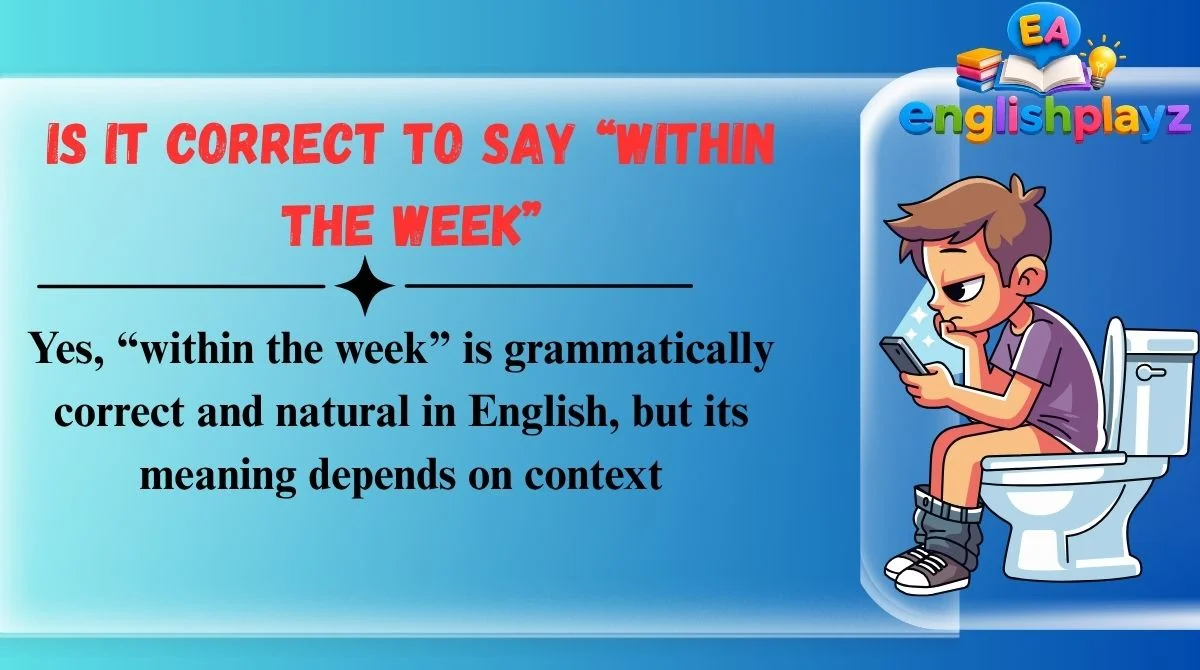
Yes, “within the week” is grammatically correct and natural in English, but its meaning depends on context. It generally means something will happen before the week ends or during a period of seven days. It is common in professional and everyday communication, although phrases like “by the end of the week” or “this week” may sometimes sound clearer.
What Does “Within the Week” Mean?
The expression “within the week” means that something will happen at some time before a week has passed. The phrase focuses on a time limit rather than a specific day or exact moment.
For example:
- “I will send you the report within the week.”
- “The company expects to announce the decision within the week.”
In both sentences, the speaker is promising that the action will happen before the week is over or within a seven-day timeframe.
However, the exact meaning can change depending on the speaker’s reference point.
Meaning 1: Before the end of the current week
Sometimes “within the week” refers to the remaining days of the current week.
Example:
“The manager will review your application and respond within the week.”
This usually means the manager will respond before the current week finishes.
Meaning 2: Within seven days from now
In other situations, “within the week” means any time during the next seven days.
Example:
“Your replacement item should arrive within the week.”
This could mean the item will arrive sometime in the next seven days, not necessarily before Friday or Sunday.
Because of this possible ambiguity, writers often choose more specific phrases when deadlines matter.
Why Is “Within the Week” Grammatically Correct?
The grammar of “within the week” is straightforward.
The phrase contains:
- Within — a preposition meaning “inside a period of time” or “before a time limit ends”
- The week — a noun phrase referring to a specific week or a seven-day period
The structure follows a normal English pattern:
within + time period
Examples:
- within an hour
- within a month
- within three days
- within the year
- within the week
All of these are grammatically acceptable.
Compare:
“I will finish the task within the week.”
This means the task will be completed before the week-long period ends.
The phrase does not need an additional word such as “next” or “coming” unless you want to specify the time period.
Incorrect:
“I will finish the task within the this week.”
Correct:
“I will finish the task within this week.”
However, even the second sentence is less natural than:
“I will finish the task within the week.”
or:
“I will finish the task this week.”
How Natural Does “Within the Week” Sound to Native Speakers?
Native English speakers generally understand “within the week” without difficulty. It sounds natural, especially when discussing deadlines, deliveries, responses, updates, or expected actions.
However, naturalness depends on the situation.
Natural examples:
“You should receive a confirmation email within the week.”
“The repair should be completed within the week.”
“I’ll get back to you within the week.”
These sound normal because they involve expected completion times.
Situations where it may sound less natural:
In casual conversation, people often choose simpler expressions.
Instead of:
“I’ll visit you within the week.”
A native speaker might say:
“I’ll visit you sometime this week.”
or:
“I’ll come by this week.”
“Within the week” can sometimes sound slightly more formal or deadline-focused.
It is not wrong, but the context affects whether it feels conversational.
Is “Within the Week” Formal, Professional, or Polite?
The phrase is often considered neutral to slightly formal. It works well in workplaces, emails, customer service messages, and official communication.
It is especially useful when someone wants to provide a timeframe without committing to an exact date.
Examples:
Professional:
“We will provide an update within the week.”
Customer service:
“Your request will be reviewed within the week.”
Business communication:
“The finance team will complete the assessment within the week.”
These sentences sound professional because they establish an expected timeframe.
However, in friendly personal messages, it may sound a little business-like.
Example:
“I’ll call you within the week.”
This is grammatically correct, but a friend might naturally say:
“I’ll call you sometime this week.”
The second version feels warmer and more casual.
When Should You Use “Within the Week”?
“Within the week” is useful when you want to communicate a flexible deadline.
Good situations include:
1. Workplace deadlines
When you cannot give an exact date:
“The revised proposal will be ready within the week.”
2. Customer updates
When explaining expected service times:
“Your order issue should be resolved within the week.”
3. Project discussions
When estimating completion:
“The development team expects to finish testing within the week.”
4. Formal writing
The phrase fits reports, notices, and professional emails.
Example:
“Applicants will receive a response within the week following the interview.”
The expression works best when the listener understands what “the week” refers to.
When Can “Within the Week” Sound Unclear or Awkward?
Although correct, the phrase can create uncertainty because it does not always identify the exact deadline.
For example:
“I will complete the work within the week.”
A reader may ask:
- Does this mean by Friday?
- Does this mean within seven days?
- Does this mean sometime before next weekend?
If timing is important, a clearer phrase is better.
Instead of:
“I will send the documents within the week.”
Consider:
“I will send the documents by Friday.”
or:
“I will send the documents within seven days.”
The best wording depends on whether you need flexibility or precision.
Examples of “Within the Week” in Real Situations
Here are examples showing different contexts:
Workplace communication
“The HR department will review your application within the week.”
This sounds professional and appropriate.
Email communication
“Thank you for your message. I will provide a detailed response within the week.”
This is polite and formal.
Customer service
“Our support team will contact you within the week to discuss the issue.”
This gives the customer a general timeframe.
Academic context
“The professor will return the graded assignments within the week.”
This is natural if the exact day is unknown.
Everyday conversation
“I should be able to finish the book within the week.”
This sounds acceptable, though “this week” may sound more casual.
Personal communication
“I’ll send you the photos within the week.”
This is understandable, but “I’ll send you the photos sometime this week” may sound more friendly.
Project planning
“The first draft should be completed within the week.”
This is common in professional settings.
Business announcements
“The company expects to release further details within the week.”
This sounds formal and appropriate.
Medical or service scheduling
“You will receive the results within the week.”
This is a common way to describe expected processing time.
Online communication
“The seller confirmed that the item will be shipped within the week.”
This sounds natural in marketplace communication.
Better Alternatives to “Within the Week”
Although “within the week” is correct, other expressions may communicate your meaning more clearly.
| Alternative | Meaning | Tone | Best Use |
|---|---|---|---|
| This week | At some point during the current week | Neutral | Everyday and professional communication |
| By the end of the week | No later than the week’s final day | Clear and specific | Deadlines and work tasks |
| Within seven days | Any time before seven days pass | Precise | Formal commitments |
| Sometime this week | At an unspecified time during the week | Casual and friendly | Personal conversations |
| Before the week is over | Before the current week ends | Natural and conversational | General communication |
“This week”
Example:
“I’ll send the invoice this week.”
This is simpler and more common in everyday speech.
“By the end of the week”
Example:
“Please submit the report by the end of the week.”
This is better when there is a firm deadline.
“Within seven days”
Example:
“The payment must be completed within seven days.”
This is more precise and often used in official situations.
Common Mistakes With “Within the Week”
Many mistakes happen because learners confuse similar time expressions.
Mistake 1: Using unnecessary words
Incorrect:
“I will finish it within the next the week.”
Correct:
“I will finish it within the week.”
or:
“I will finish it within the next week.”
Mistake 2: Confusing “within” and “during”
“Within” focuses on a deadline.
Example:
“I will reply within the week.”
This means before the week ends.
“During” focuses on when something happens.
Example:
“I will be traveling during the week.”
This means at some point throughout the week.
Mistake 3: Using it for exact dates
Incorrect:
“I will finish the project within Monday.”
Correct:
“I will finish the project by Monday.”
“Within” usually works with periods, not single points in time.
Mistake 4: Assuming everyone understands the same timeframe
If the deadline matters, avoid leaving the timeframe unclear.
Instead of:
“The changes will be made within the week.”
Use:
“The changes will be made by Friday.”
Regional Differences in American and British English
The phrase “within the week” is acceptable in both American and British English. There is no major regional difference in correctness.
Both speakers commonly use similar alternatives:
American English:
“I’ll get back to you this week.”
British English:
“I’ll get back to you this week.”
The main difference is not regional but contextual. Some speakers may prefer simpler expressions like “this week” in casual situations, while “within the week” remains common in professional communication.
How to Choose the Best Expression for Your Audience
Choosing between “within the week” and other options depends on your relationship with the reader and the importance of accuracy.
For a manager or client
Use:
“I will provide the completed report by Friday.”
A specific deadline sounds responsible.
For a coworker
Use:
“I’ll send it over this week.”
This feels natural and cooperative.
For a customer
Use:
“You will receive an update within the week.”
This gives a professional timeframe.
For a friend
Use:
“I’ll send you the pictures sometime this week.”
This sounds warmer.
The phrase itself is not the issue. The goal is choosing wording that matches the situation.
FAQs
Is “within the week” grammatically correct?
Yes, “within the week” is grammatically correct. It uses the normal English structure “within + time period.” The phrase means something will happen before the week ends or within a seven-day period, depending on the context.
What does “within the week” mean in an email?
In an email, “within the week” usually means the sender expects to complete an action before the week finishes. It is often used for updates, responses, reports, or decisions when the exact day is not known.
Is “within the week” professional?
Yes, “within the week” is suitable for professional communication. It sounds neutral and slightly formal, making it appropriate for workplace emails, customer service messages, and business updates.
Is “within the week” better than “this week”?
Not always. “Within the week” emphasizes a timeframe or deadline, while “this week” simply means sometime during the current week. For casual communication, “this week” often sounds more natural.
Can I say “within this week”?
Yes, “within this week” is grammatically possible, but it is less common than “within the week.” Most native speakers would usually say “this week” or “within the week” instead.
What is a clearer alternative to “within the week”?
The clearest alternative depends on your meaning. Use “by the end of the week” for a deadline, “within seven days” for precision, or “sometime this week” for a casual and flexible meaning.
Final Thoughts
Yes, “within the week” is correct and natural English, especially in professional, formal, and deadline-related situations. It means something will happen before the end of a week-long period, although the exact timeframe may depend on context.
The phrase is useful when you want to provide flexibility without choosing a specific date. However, if clarity is important, alternatives such as “by the end of the week” or “within seven days” may communicate your meaning more effectively.
For everyday conversations, “this week” or “sometime this week” may sound more relaxed and natural. For workplace communication, “within the week” remains a professional and widely accepted choice.
The best wording depends on your audience, purpose, and how precise your timing needs to be.

I am Sayan Roy, an English language enthusiast dedicated to helping readers understand word meanings, vocabulary, grammar, and useful English expressions through clear, simple, and informative content.