The phrase “thank you all” is a common expression, but many speakers still wonder: is it correct to say thank you all alternatives when looking for more natural ways to express gratitude? The short answer is that “thank you all” is completely correct and widely used in modern English. However, the best alternative depends on the situation, relationship, and level of formality.
“Thank you all” can sound warm, friendly, professional, or slightly less formal depending on the context. It is often used when speaking to a group of people, such as coworkers, friends, an audience, or a community. In some situations, another phrase may sound more personal or more suitable.
This article explains the meaning, grammar, tone, and usage of “thank you all,” along with natural alternatives for conversations, emails, workplace communication, and formal situations.
Is It Correct to Say “Thank You All”?
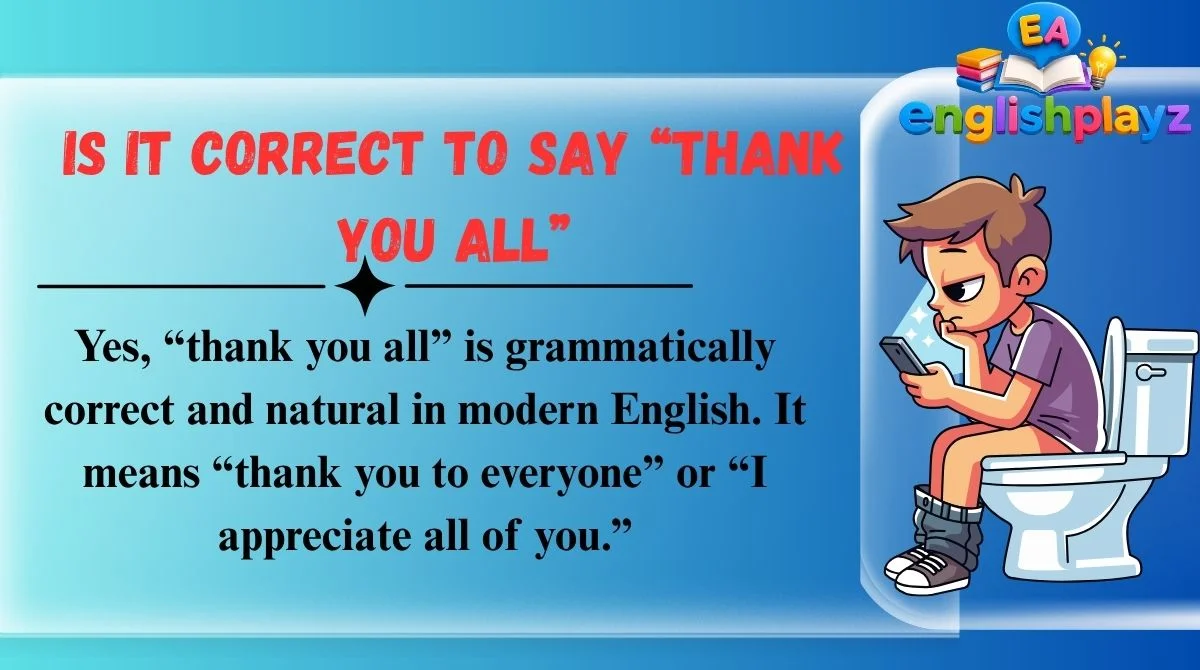
Yes, “thank you all” is grammatically correct and natural in modern English. It means “thank you to everyone” or “I appreciate all of you.” The phrase is commonly used when addressing multiple people who have provided help, support, kindness, congratulations, or assistance. It is generally warm and polite, although more formal settings may require a slightly different expression.
What Does “Thank You All” Mean?
“Thank you all” is a direct expression of gratitude addressed to a group rather than a single person. The word “all” works as a determiner or pronoun referring to everyone included in the group.
For example:
- “Thank you all for coming to my birthday party.”
- “Thank you all for your hard work on this project.”
- “Thank you all for your support during this difficult time.”
In each example, the speaker is thanking multiple people collectively.
The expression does not mean that every individual did exactly the same thing. Instead, it communicates appreciation toward the entire group.
Compare these sentences:
- “Thank you, Sarah.” → gratitude toward one person.
- “Thank you all.” → gratitude toward a group.
- “Thank you both.” → gratitude toward two people.
- “Thank you everyone.” → gratitude toward a larger group.
The meaning is simple, but the emotional effect can vary. In a workplace meeting, “thank you all” may sound professional and appreciative. In a message to friends, it may sound affectionate and personal.
Why “Thank You All” Is Grammatically Correct
The structure of “thank you all” follows normal English grammar.
The basic pattern is:
Thank + person or group being thanked
Examples:
- Thank you, John.
- Thank you, everyone.
- Thank you all.
- Thank you both.
In “thank you all,” the word “you” is the object of the verb “thank,” while “all” emphasizes that the speaker is referring to every person in the group.
A common misunderstanding is that “thank you all” might be incorrect because “you” is usually singular and plural in English. However, modern English uses “you” for both one person and multiple people. The word “all” simply clarifies that the message is directed at a group.
Correct:
- “Thank you all for helping me move.”
- “Thank you all for attending the meeting.”
Incorrect or unnatural:
- “Thank all you.”
- “Thanks all of you people.”
The first example has the wrong word order. The second is grammatically possible in some contexts but often sounds unnecessary or awkward.
How Natural Does “Thank You All” Sound to Native Speakers?
Native English speakers commonly use “thank you all,” especially when addressing groups. It sounds natural in speeches, conversations, announcements, social media posts, and workplace messages.
However, the position of “all” can slightly affect the tone.
Compare:
- “Thank you all for your help.”
- “Thank you for all your help.”
These sentences are both correct, but they mean different things.
“Thank you all for your help” means:
- Thank you, everyone, for helping me.
“Thank you for all your help” means:
- I appreciate the amount or extent of help you provided.
Both are natural, but the focus changes.
Examples:
Natural:
- “Thank you all for making this event successful.”
- “Thank you all for joining today’s discussion.”
- “Thank you all for the wonderful messages.”
Less natural:
- “Thank all of you very much everyone.”
The last sentence contains unnecessary repetition.
Is “Thank You All” Formal, Informal, or Professional?
“Thank you all” is flexible. It is neither strictly formal nor strictly informal. Its tone depends on the setting.
Professional use
In workplaces, “thank you all” is acceptable and often appreciated.
Examples:
- “Thank you all for your contributions to this project.”
- “Thank you all for attending today’s training session.”
- “I want to thank you all for your continued support.”
It works well in team emails, meetings, presentations, and company announcements.
Informal use
Among friends or family, “thank you all” sounds friendly and natural.
Examples:
- “Thank you all for the birthday wishes!”
- “Thank you all for coming over last night.”
- “Thank you all, you really made my day.”
Formal situations
For very formal writing, such as official statements or ceremonies, alternatives may sound more polished:
- “I would like to express my gratitude to everyone.”
- “I sincerely appreciate everyone’s support.”
“Thank you all” is not wrong in formal settings, but a more formal expression may better match the occasion.
When Should You Use “Thank You All”?
“Thank you all” is especially appropriate when you are thanking a group of people at once.
Common situations include:
After receiving support
Example:
- “Thank you all for your kind words and encouragement.”
After a group event
Example:
- “Thank you all for attending the conference.”
After teamwork
Example:
- “Thank you all for your effort and dedication.”
At the end of a presentation
Example:
- “Thank you all for listening. I’m happy to answer any questions.”
In online communication
Example:
- “Thank you all for your comments and feedback.”
The phrase works because it recognizes the group as a whole.
When Might “Thank You All” Sound Less Suitable?
Although “thank you all” is correct, there are situations where another phrase may be better.
When you want to sound very personal
If someone provided individual help, “thank you all” may feel too general.
Less personal:
- “Thank you all for helping me.”
More personal:
- “Thank you, Anna, for staying late to help me finish this.”
When writing a highly formal message
A formal letter may benefit from a more traditional phrase.
Instead of:
- “Thank you all for your cooperation.”
You might write:
- “We sincerely appreciate your cooperation.”
When thanking a small number of specific people
If only one or two people are involved, naming them may feel more thoughtful.
Example:
Better:
- “Thank you, Mark and Lisa, for your support.”
Less effective:
- “Thank you all.”
The second phrase is grammatically correct but less specific.
Best Alternatives to “Thank You All” and Their Differences
There are many natural alternatives, but each carries a slightly different tone.
| Alternative | Meaning and Best Use |
|---|---|
| Thank you everyone | Very similar to “thank you all”; common for groups and audiences |
| Thanks everyone | More casual and friendly |
| I appreciate you all | Warmer and more personal |
| I’m grateful to you all | More emotional and sincere |
| Many thanks, everyone | Polite and slightly more formal |
| Thank you so much, everyone | More enthusiastic and appreciative |
| I would like to thank everyone | Formal and suitable for speeches or writing |
“Thank you everyone”
This is one of the closest alternatives.
Example:
- “Thank you everyone for being here today.”
It is especially common in spoken English.
“Thanks everyone”
This is more casual.
Example:
- “Thanks everyone for helping with the move.”
It is suitable for friends, classmates, and informal workplace chats.
“I appreciate you all”
This sounds warmer because it focuses on appreciation rather than only gratitude.
Example:
- “I appreciate you all for supporting me throughout this journey.”
“I would like to thank everyone”
This is more formal.
Example:
- “I would like to thank everyone who contributed to this research.”
It is common in presentations, awards, and official statements.
How to Use “Thank You All” in Emails and Workplace Messages
“Thank you all” works well in professional emails when addressing a team.
Examples:
Team appreciation email:
“Thank you all for your hard work and commitment during this project. Your efforts helped us achieve excellent results.”
Meeting follow-up:
“Thank you all for attending today’s meeting and sharing your valuable ideas.”
Project completion message:
“Thank you all for your dedication. I appreciate the time and energy everyone invested.”
However, avoid using “thank you all” as a complete professional message when more detail is needed.
Too brief:
- “Thank you all.”
Better:
- “Thank you all for your quick response and continued support.”
Adding the reason makes the message more meaningful.
Common Mistakes With “Thank You All”
Although the phrase is simple, several mistakes appear frequently.
Mistake 1: Adding unnecessary words
Incorrect:
- “Thank you all of everyone.”
Better:
- “Thank you all.”
- “Thank you everyone.”
Mistake 2: Using it for one person
Incorrect:
- “Thank you all, Sarah.”
If Sarah is only one person, use:
- “Thank you, Sarah.”
Mistake 3: Confusing “thank you all” with “thanks to all”
These phrases are related but used differently.
“Thank you all” is a direct expression of gratitude.
Example:
- “Thank you all for your help.”
“Thanks to all” is often used in a broader statement.
Example:
- “Thanks to all who participated in the event.”
Mistake 4: Forgetting punctuation
When directly addressing people, a comma is often used:
- “Thank you all for your support.”
- “Thank you, everyone, for your support.”
The comma helps show that “everyone” is being addressed.
American and British English Usage of “Thank You All”
“Thank you all” is widely understood and used in both American and British English.
There is no major difference in meaning between the two varieties.
American English examples:
- “Thank you all for coming tonight.”
- “I want to thank you all for your hard work.”
British English examples:
- “Thank you all for your help.”
- “Thank you all very much.”
Both forms sound natural.
Small differences may appear in preferred alternatives. For example, “thanks everyone” is common in casual American and British speech, while “many thanks” may sound slightly more common in some British professional writing. However, these are matters of style, not correctness.
FAQs
Is “thank you all” grammatically correct?
Yes, “thank you all” is grammatically correct. It is a standard way to thank multiple people at the same time. The word “all” indicates that the gratitude is directed toward every person in the group.
Can you say “thank you all” in a professional email?
Yes, you can use “thank you all” in professional emails, especially when addressing a team or group. It sounds polite and appreciative. For highly formal communication, “I would like to thank everyone” or “we sincerely appreciate your support” may sound more appropriate.
What is the difference between “thank you all” and “thank you everyone”?
The difference is very small. Both expressions thank a group of people. “Thank you everyone” is often used when speaking to an audience, while “thank you all” can feel slightly more direct and personal.
Is “thanks all” correct English?
“Thanks all” is understandable and used in some informal situations, especially in casual online communication. However, “thanks everyone” or “thanks all of you” may sound more natural to many speakers. For professional settings, “thank you all” is usually better.
What is a warmer alternative to “thank you all”?
Warmer alternatives include “I appreciate you all,” “I’m truly grateful to everyone,” and “thank you so much, everyone.” These expressions add more emotional emphasis and are useful when you want to show deeper appreciation.
Can “thank you all” be used at the end of a speech?
Yes. “Thank you all for listening” is a very common way to close a speech, presentation, or public announcement. It is polite, clear, and appropriate for many audiences.
Final Thoughts
The answer to “is it correct to say thank you all alternatives” is that “thank you all” itself is absolutely correct, natural, and widely accepted English. It is a simple but effective phrase for expressing gratitude to a group of people.
The expression works in everyday conversations, workplace communication, emails, speeches, and online messages. Its tone is usually polite and friendly, although a more formal alternative may be better in official contexts.
If you want a direct and natural group thank-you, use “thank you all.” If you want a warmer message, consider “I appreciate you all” or “I’m grateful to everyone.” If you need a more formal tone, “I would like to thank everyone” may be the stronger choice.
Choosing the right phrase depends less on grammar and more on the relationship, situation, and feeling you want to communicate.

I am Sayan Roy, an English language enthusiast dedicated to helping readers understand word meanings, vocabulary, grammar, and useful English expressions through clear, simple, and informative content.