Many English learners and speakers ask, “is it correct to say please and thank you?” because the expression sounds familiar but may seem unusual as a complete phrase.
The short answer is yes: “please and thank you” is grammatically correct and widely understood in modern English. However, its meaning and tone depend heavily on the situation.
The expression can describe basic manners, emphasize politeness, or remind someone to use polite words. In some contexts, it sounds warm and friendly.
In others, especially when said with a particular tone of voice, it may sound slightly humorous, firm, or even sarcastic.
This article explains what “please and thank you” means, whether it is natural for native speakers, how to use it correctly, when it works well, when to avoid it, and what alternatives may sound more appropriate in different situations.
Is It Correct to Say “Please and Thank You”?
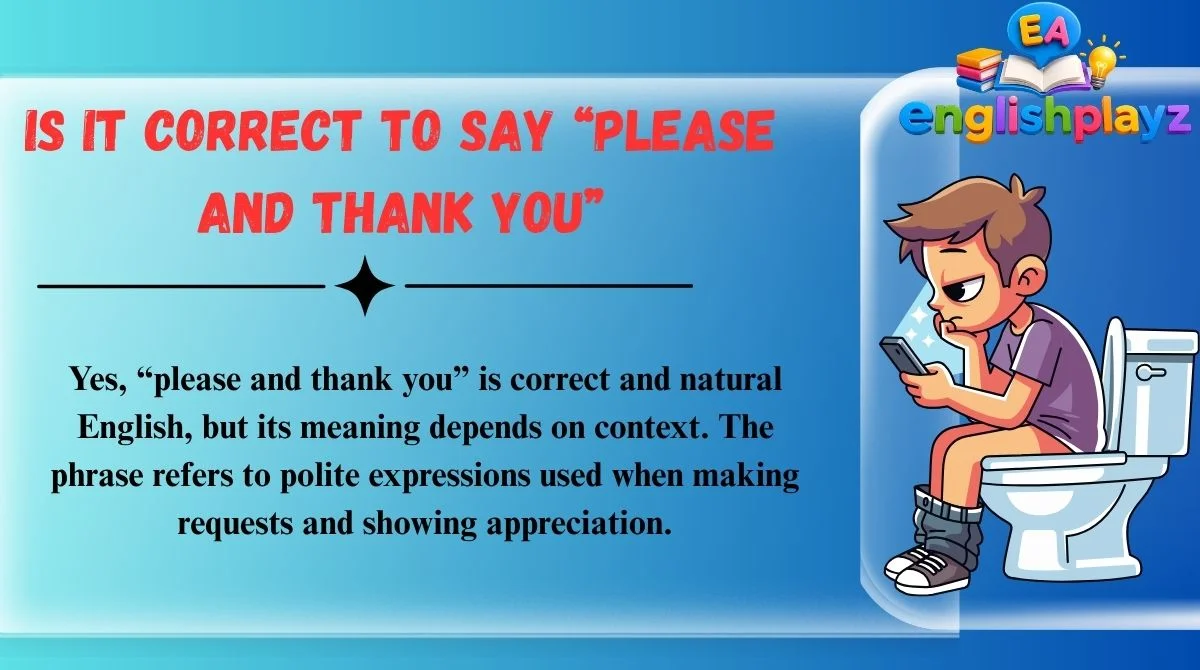
Yes, “please and thank you” is correct and natural English, but its meaning depends on context. The phrase refers to polite expressions used when making requests and showing appreciation. It is commonly used when teaching manners, emphasizing courtesy, or playfully reminding someone to be polite. In professional situations, however, complete sentences such as “Could you please help me?” or “Thank you for your assistance” are usually more suitable.
What Does “Please and Thank You” Mean in English?
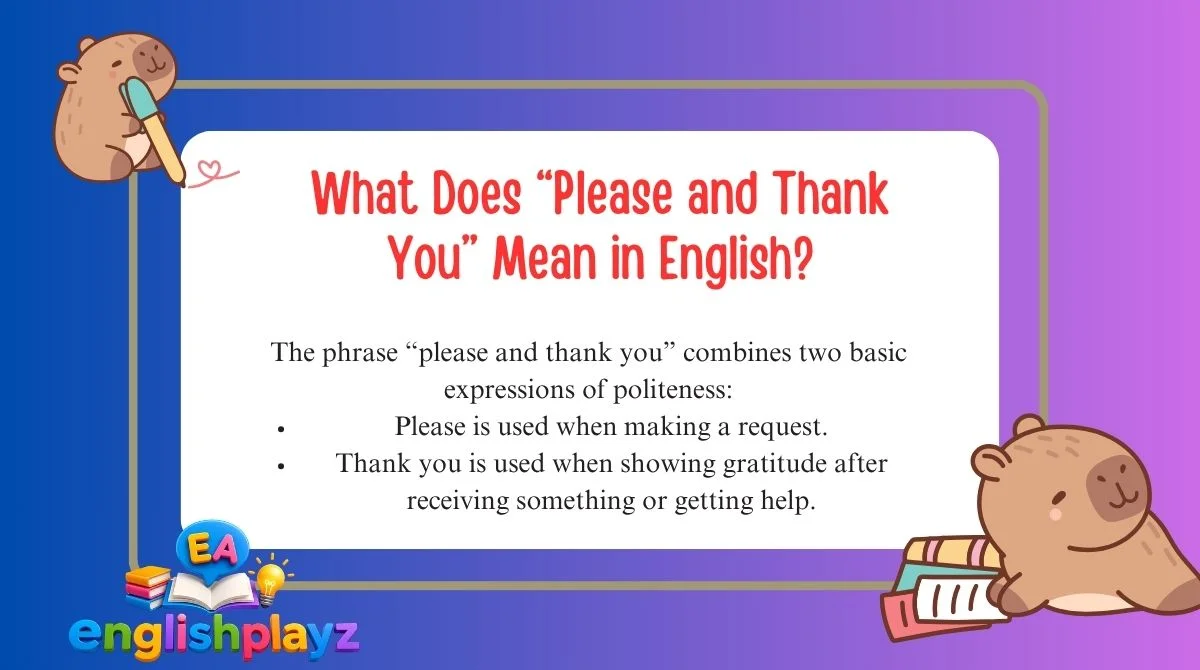
The phrase “please and thank you” combines two basic expressions of politeness:
- Please is used when making a request.
- Thank you is used when showing gratitude after receiving something or getting help.
Together, the phrase represents good manners and respectful communication.
For example:
- A parent may teach a child: “Remember to say please and thank you.”
- A teacher may remind students: “Using please and thank you shows respect.”
- A friend may jokingly say: “Where are my please and thank you?”
The expression does not usually mean that someone must literally say both words together every time. Instead, it represents the general idea of being polite.
For example:
“Good manners include saying please and thank you.”
This means that polite people use appropriate requests and expressions of gratitude.
However, if someone says:
“Please and thank you.”
after giving an instruction, the meaning can change. It may function as a polite but slightly firm reminder, similar to saying:
“Please do this, and I expect you to acknowledge it politely.”
The speaker’s tone is important.
Is “Please and Thank You” Grammatically Correct?
From a grammar perspective, “please and thank you” is a correct phrase. It is a coordination of two common expressions joined by the conjunction and.
The structure is:
please + and + thank you
Both parts are socially recognized expressions:
- “Please” functions as a politeness marker added to requests.
- “Thank you” functions as an expression of gratitude.
Because they are both established phrases, combining them is grammatically acceptable.
However, grammar and natural usage are different things. A phrase can be grammatically correct but not suitable in every situation.
For example:
Correct:
“Children should learn to say please and thank you.”
This sounds completely natural.
Also correct:
“Please and thank you are important parts of polite conversation.”
This is grammatically acceptable, although many speakers would naturally say:
“Saying please and thank you is an important part of polite conversation.”
The second version sounds smoother because it focuses on the action rather than treating the expressions as objects.
How Natural Does “Please and Thank You” Sound to Native Speakers?
Native English speakers commonly understand “please and thank you,” and it sounds natural in many everyday situations. It is especially common in conversations about manners, parenting, education, and social behavior.
Examples:
“My parents always taught me to say please and thank you.”
“The children are learning their please and thank yous.”
“A simple please and thank you can make a big difference.”
However, native speakers do not usually use the phrase as a replacement for a full polite request or response.
For example:
Less natural:
“Please and thank you, send me the report.”
More natural:
“Could you please send me the report? Thank you.”
The first sentence may sound playful, impatient, or intentionally informal. The second sounds professional and respectful.
The phrase is most natural when discussing politeness itself, rather than performing politeness in a formal interaction.
Is “Please and Thank You” Polite, Formal, or Informal?
The tone of “please and thank you” changes depending on the speaker, relationship, and situation.
Warm and polite use
When teaching or encouraging good manners:
“Always remember your please and thank you.”
This sounds caring and positive.
Casual or humorous use
Friends may use it jokingly:
“You can borrow my car, but I expect a please and thank you.”
This is playful rather than serious.
Firm or slightly sarcastic use
A person may say:
“A please and thank you would be nice.”
This may suggest that someone was rude or forgot basic courtesy.
Professional use
In workplace communication, the phrase is usually better used when discussing manners rather than making requests.
For example:
Appropriate:
“Customer service training should emphasize the importance of please and thank you.”
Less appropriate:
“Please and thank you, finish the document by Friday.”
In professional environments, direct but complete polite sentences are preferred.
When Should You Use “Please and Thank You”?
The phrase works well in several common situations.
1. Teaching children manners
This is one of the most common uses.
Example:
“What do we say when someone gives us something? We say thank you.”
“Remember your please and thank you when you visit your grandparents.”
2. Talking about politeness generally
The phrase is useful when discussing respectful communication.
Example:
“Using please and thank you helps create a positive impression.”
3. Making a lighthearted reminder
Among friends or family, it can sound friendly.
Example:
“You want me to make you coffee? Please and thank you?”
4. Describing someone’s manners
Example:
“She was raised to always use her please and thank you.”
In these contexts, the expression sounds natural because it refers to the concept of politeness.
When Should You Avoid Saying “Please and Thank You”?
Although the phrase is correct, there are situations where it may sound awkward.
In formal requests
Avoid using it instead of a complete professional request.
Awkward:
“Please and thank you, review this document.”
Better:
“Could you please review this document? Thank you for your help.”
When the listener may feel criticized
Sometimes “please and thank you” can sound like a complaint.
Example:
“Where is my please and thank you?”
This may sound humorous with a close friend but rude with a colleague.
In serious professional communication
Business emails, official requests, and customer communication usually require specific polite wording.
Instead of:
“Please and thank you for your cooperation.”
Use:
“Thank you for your cooperation.”
or:
“I would appreciate your assistance with this matter.”
The key is matching the phrase to the relationship and purpose.
How to Use “Please and Thank You” in Emails and Workplace Communication
In professional writing, “please and thank you” is usually not used as a combined phrase. Workplace communication values clarity, respect, and professionalism.
Natural workplace examples:
“Could you please send the updated figures by Thursday? Thank you.”
“Please review the attached file, and thank you for your time.”
“I appreciate your help with this project. Thank you.”
These examples separate the request and gratitude naturally.
Less suitable workplace example:
“Please and thank you, send the information as soon as possible.”
Although understandable, it may sound too casual or like a spoken reminder rather than a professional message.
For emails, the best approach is:
- Use please when making a request.
- Use thank you when expressing appreciation.
- Add details that show respect.
For example:
“Could you please confirm whether the meeting time works for you? Thank you for your assistance.”
This sounds polished and professional.
What Are Better Alternatives to “Please and Thank You”?
The best alternative depends on what you want to communicate.
| Expression | Tone | Best Use |
|---|---|---|
| “Could you please…?” | Polite and professional | Workplace requests |
| “Thank you for your help.” | Appreciative | Professional and personal situations |
| “I appreciate it.” | Friendly and natural | Everyday conversations |
| “I’d be grateful if you could…” | Formal | Business or official writing |
| “Thanks so much.” | Warm and informal | Friends and casual communication |
| “Would you mind…?” | Polite and indirect | Requests where you want to sound considerate |
Examples:
Instead of:
“Please and thank you, send me the file.”
Say:
“Could you please send me the file?”
Instead of:
“Please and thank you for helping.”
Say:
“Thank you for helping.”
Instead of:
“Remember your please and thank you.”
You might say:
“Remember to be polite.”
The original phrase is not wrong; these alternatives simply fit specific situations better.
Common Mistakes When Using “Please and Thank You”
Several mistakes occur because learners assume the phrase works the same way as individual polite expressions.
Mistake 1: Using it as a complete workplace request
Incorrect or awkward:
“Please and thank you, complete the task today.”
Better:
“Could you please complete the task today? Thank you.”
Mistake 2: Forgetting that tone changes meaning
The words themselves are polite, but the delivery matters.
For example:
“Please and thank you.”
said warmly may sound friendly.
The same words said sharply may sound like a warning or criticism.
Mistake 3: Using it where gratitude is expected alone
Awkward:
“Please and thank you for your support.”
Better:
“Thank you for your support.”
“Please” is unnecessary because there is no request.
Mistake 4: Treating it as a fixed rule
Politeness is not only about saying specific words. Context, tone, and respect also matter.
A sincere:
“I really appreciate your help.”
may communicate more warmth than simply saying:
“Thank you.”
Regional Differences in American and British English
“Please and thank you” is understood across major English-speaking regions, including the United States, United Kingdom, Canada, and Australia.
The expression does not have a major difference in meaning between American and British English. However, the way people use politeness expressions can vary slightly.
British English is often associated with frequent use of polite markers in everyday requests:
“Could you possibly help me, please?”
American English often uses simpler direct requests:
“Could you help me, please?”
Both are polite and natural.
In all regions, “please and thank you” is most commonly used when discussing manners or reminding someone to be polite, rather than as a formal request formula.
Examples:
American English:
“Kids need to learn their please and thank you.”
British English:
“Children should learn to say please and thank you.”
Both sound natural.
FAQs
Is “please and thank you” grammatically correct?
Yes, “please and thank you” is grammatically correct. It combines two standard expressions of politeness. However, its suitability depends on context. It is most natural when discussing manners, teaching politeness, or making a friendly reminder rather than replacing a complete request.
Can you say “please and thank you” in a sentence?
Yes, you can. For example: “Parents often teach their children to say please and thank you.” It can also appear in casual speech, but it may sound unusual if used alone as a formal request.
Is “please and thank you” professional?
Usually, it is not the best choice for professional requests. In workplace communication, phrases like “Could you please…” and “Thank you for your assistance” sound clearer and more polished.
Does “please and thank you” sound rude?
Not normally, but tone matters. A friendly speaker may use it warmly, while someone saying it sharply may sound demanding or sarcastic. The phrase itself is polite, but the delivery affects how listeners interpret it.
What is another way to say “please and thank you”?
Depending on the meaning, alternatives include “good manners,” “polite expressions,” “courtesy,” “thank you for your help,” or “could you please.” The best choice depends on whether you are discussing manners or making a request.
Should I write “please and thank you” in an email?
You can write it when discussing politeness, but avoid using it as a substitute for professional wording. In emails, separate your request and gratitude for a more natural tone.
Final Thoughts
The answer to “is it correct to say please and thank you?” is yes. The expression is grammatically correct, widely understood, and natural in everyday English when talking about manners, teaching politeness, or making a friendly reminder.
However, it is not always the best choice for direct communication. In professional emails, workplace requests, and formal situations, complete phrases such as “Could you please…” and “Thank you for your assistance” usually sound more appropriate.
The most important point is that “please and thank you” represents a broader idea: showing respect and appreciation.
Use it when discussing courtesy, but choose more specific wording when you need to make a request or express gratitude in a particular situation.

I am Sayan Roy, an English language enthusiast dedicated to helping readers understand word meanings, vocabulary, grammar, and useful English expressions through clear, simple, and informative content.