Many English speakers wonder, is it correct to say make a long story short, especially when they hear the phrase in conversations, meetings, or writing.
The answer is not simply about grammar; it is also about tone, context, and how natural the expression sounds in modern English. “Make a long story short” is a well-established English idiom, but it has specific uses and can sometimes create a particular impression depending on the situation.
This article explains what “make a long story short” means, why it is grammatically correct, how native speakers use it, whether it is professional or informal, and when another expression may work better.
You will also learn common mistakes, examples, and alternatives so you can choose the right wording for conversations, emails, and workplace communication.
Is It Correct to Say “Make a Long Story Short”?
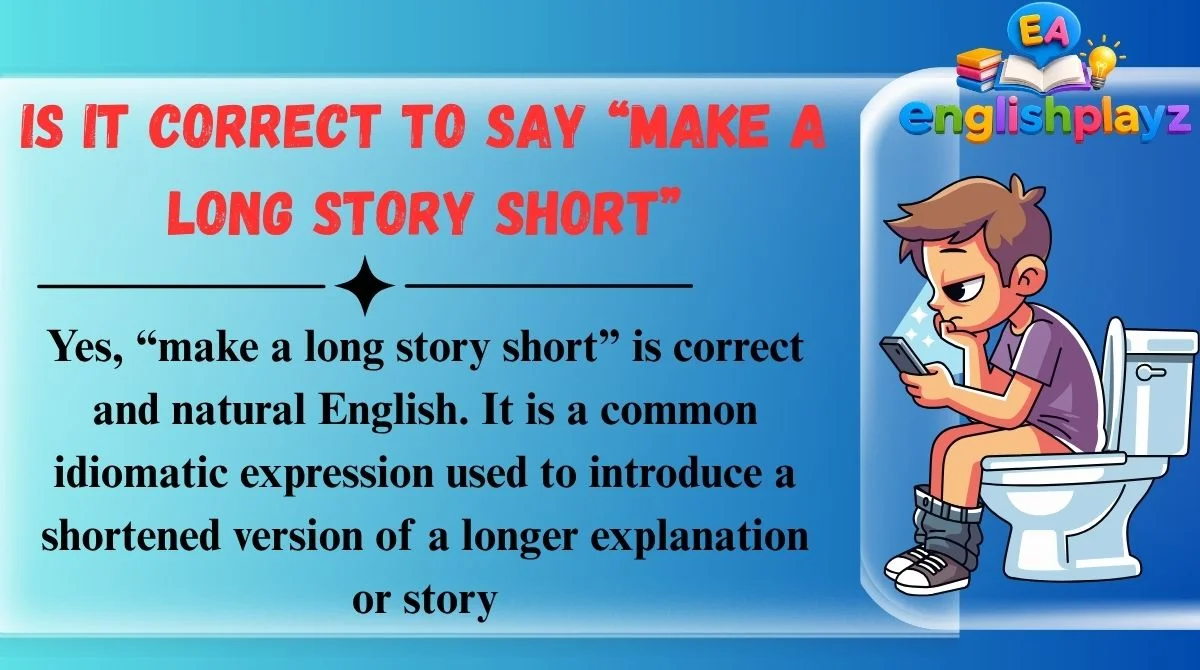
Yes, “make a long story short” is correct and natural English. It is a common idiomatic expression used to introduce a shortened version of a longer explanation or story. It means “to summarize the important part” or “to skip unnecessary details and give the main point.” The phrase is generally informal and conversational, although it can appear in some professional contexts when used appropriately.
What Does “Make a Long Story Short” Mean?
The expression “make a long story short” means to reduce a lengthy explanation, event, or story into a brief summary. A speaker uses it when they want to move quickly from background details to the final result or most important information.
For example:
“I had several problems with my car, visited three different mechanics, and waited weeks for parts. To make a long story short, I had to buy a new vehicle.”
In this sentence, the speaker does not explain every detail. Instead, they provide the conclusion: buying a new vehicle.
The phrase does not literally mean that someone is changing the length of a story. It is an idiom, which means the meaning comes from common usage rather than the individual words alone.
Similar meanings include:
- “In summary”
- “Briefly”
- “To summarize”
- “The short version is”
- “The main point is”
- “Long story short”
Native English speakers usually understand it as a signal that a summary or conclusion is coming.
Why Is “Make a Long Story Short” Grammatically Correct?
The structure of “make a long story short” may seem unusual to English learners because it uses the verb “make” in a way that is not always literal. However, the grammar is correct because “make” can mean “cause something to become” or “change something into a particular state.”
Examples of this structure include:
- “Make the problem clear.”
- “Make the explanation simpler.”
- “Make the process easier.”
In “make a long story short,” the adjective “short” describes the result being created. The phrase means “cause a long story to become short.”
The grammatical pattern is:
make + object + adjective
Examples:
- Make the room clean.
- Make the instructions clear.
- Make a long story short.
The object is “a long story,” and the adjective describing the result is “short.”
Because this structure follows normal English grammar patterns, the expression is not only understandable but grammatically sound.
How Natural Does “Make a Long Story Short” Sound to Native Speakers?
“Make a long story short” sounds natural to most native English speakers. It is a familiar idiom used in everyday conversation, storytelling, and informal communication.
However, its naturalness depends on timing and context. If someone uses it after providing only a small amount of information, it may sound unnecessary.
For example:
“I went to the store. To make a long story short, I bought milk.”
This sounds slightly strange because there was no long story to shorten.
The phrase works best when:
- The explanation is genuinely long
- The speaker has already mentioned several details
- The listener wants the main point
- The speaker is moving toward a conclusion
A natural example:
“I applied for several jobs, had multiple interviews, and waited for months. To make a long story short, I finally accepted an offer from a technology company.”
Here, the phrase fits because there is a longer process being summarized.
Is “Make a Long Story Short” Formal or Informal?
“Make a long story short” is usually considered informal to neutral. It is common in spoken English and casual writing, but it is not usually the best choice for highly formal documents.
It works well in:
- Conversations with friends
- Personal emails
- Informal workplace discussions
- Presentations with a conversational style
- Social media posts
It may be less suitable in:
- Academic papers
- Legal documents
- Formal reports
- Official business correspondence
For example, a manager speaking casually in a meeting might say:
“To make a long story short, we decided to postpone the launch.”
This is perfectly acceptable.
However, in a formal report, a better choice would be:
“In summary, the launch was postponed.”
The difference is not correctness. Both expressions are grammatical. The difference is tone.
Is “Make a Long Story Short” Polite and Appropriate?
The phrase is generally polite, but its effect depends on how it is used. It can show consideration because the speaker is trying to save the listener’s time.
For example:
“I won’t go through every detail. To make a long story short, the project was successful.”
This sounds helpful and efficient.
However, it can sometimes sound dismissive if used to cut off someone else’s explanation.
For example:
“Make a long story short, you were wrong.”
Although grammatically possible, this could sound impatient or overly direct because the phrase is being used to reduce another person’s argument.
Tone matters. The expression is usually friendlier when summarizing your own story rather than someone else’s explanation.
Using “Make a Long Story Short” in Professional Communication
In workplace conversations, “make a long story short” can be acceptable when the environment is relaxed. Many professionals use it when speaking with colleagues or giving a quick update.
Examples:
“To make a long story short, the client approved the proposal.”
“I’ll explain the background later, but to make a long story short, we need to change the schedule.”
These examples sound natural in meetings or conversations.
For professional writing, especially emails to clients or formal documents, more precise phrases are often better.
Instead of:
“To make a long story short, we missed the deadline because of technical problems.”
You could write:
“In summary, technical issues caused a delay in completing the project.”
The second version sounds more formal and businesslike.
The best choice depends on the relationship with the reader and the purpose of the message.
How to Use “Make a Long Story Short” in Emails and Writing
Although the phrase is common in speech, it can appear in written communication. The key is choosing the right audience.
A friendly email:
“I won’t include all the details here. To make a long story short, the event went better than expected.”
This sounds natural.
A professional email:
“To summarize, the revised plan addresses the main concerns raised during the meeting.”
This is usually stronger.
In workplace emails, alternatives such as “to summarize,” “in brief,” or “the main point is” often sound clearer because readers usually prefer direct communication.
Avoid using the phrase repeatedly in writing. Because it is an idiom, using it too often can make writing feel conversational or less polished.
Common Mistakes When Using “Make a Long Story Short”
English learners sometimes make mistakes with this expression because it is an idiom.
Mistake 1: Changing the word order
Incorrect:
“Make short a long story.”
Correct:
“Make a long story short.”
The adjective comes after the object in this structure.
Mistake 2: Using “make the long story short”
The standard expression uses “a”:
Correct:
“To make a long story short, we reached an agreement.”
“Make the long story short” may be understandable, but it is not the usual idiomatic form.
Mistake 3: Using it when there is no long explanation
Incorrectly awkward:
“I woke up at seven. To make a long story short, I drank coffee.”
The phrase suggests that important details were removed, but there are no details to remove.
Mistake 4: Confusing it with “short story”
A “short story” is a type of written fiction. “Make a long story short” does not mean creating a short story. It means summarizing information.
Better Alternatives to “Make a Long Story Short” and Their Differences
Different situations call for different expressions. Here are some useful alternatives:
| Expression | Tone | Best Use |
|---|---|---|
| To summarize | Neutral and professional | Reports, emails, presentations |
| In short | Neutral and concise | Speaking and writing |
| Long story short | Casual | Conversations and informal messages |
| The short version is | Friendly and conversational | Explaining situations |
| In a nutshell | Informal | Quick summaries |
| The main point is | Direct and clear | Discussions and explanations |
“Long story short”
This is a shortened version of the same idea and is extremely common in casual speech.
Example:
“Long story short, we decided not to move.”
It sounds natural but informal.
“In summary”
This is more professional.
Example:
“In summary, the research supports the proposed changes.”
“In a nutshell”
This is friendly and informal.
Example:
“In a nutshell, the company needs a better communication strategy.”
Choosing the right alternative depends on whether you want to sound casual, professional, warm, or direct.
“Make a Long Story Short” vs. Similar Expressions
Some expressions are related but have slightly different meanings.
“Get to the point”
This focuses on reaching the important information quickly.
Example:
“Can you get to the point?”
This can sound impatient depending on tone.
“Bottom line”
This emphasizes the final result or most important fact.
Example:
“The bottom line is that we need more funding.”
It is common in business settings.
“To cut a long story short”
This is a British English variant that has the same meaning as “make a long story short.”
Example:
“To cut a long story short, we missed the train.”
Both expressions are correct. “Make a long story short” is widely used, especially in American English.
FAQs
Is “make a long story short” grammatically correct?
Yes, “make a long story short” is grammatically correct. It follows the structure “make + object + adjective,” where “short” describes the result of changing the story. It is also a common English idiom.
Can you say “make a long story short” in professional settings?
Yes, you can use it in professional conversations, especially with colleagues in informal or relaxed environments. However, in formal emails, reports, or official documents, phrases like “to summarize” or “in conclusion” may sound more appropriate.
What does “make a long story short” mean?
“Make a long story short” means to give only the most important information from a longer explanation. It introduces a summary and usually leads to the final result or main point.
Is “make a long story short” polite?
Generally, yes. It can show that you respect someone’s time by avoiding unnecessary details. However, it may sound dismissive if used to quickly reject or oversimplify someone else’s explanation.
Is “long story short” different from “make a long story short”?
The meanings are almost the same. “Long story short” is a shorter, more casual version often used in conversation. “Make a long story short” is the traditional full expression.
What are better alternatives to “make a long story short”?
Better alternatives depend on the situation. “To summarize” is more professional, “in short” is neutral, and “the short version is” is friendly and conversational.
Final Thoughts
Yes, it is correct to say “make a long story short.” The expression is grammatically accurate, widely understood, and natural in modern English. It is an idiom used to introduce a shortened explanation or highlight the most important part of a longer story.
The main consideration is not correctness but suitability. “Make a long story short” is usually conversational and works well in everyday speech, informal messages, and relaxed workplace communication. For formal writing, “to summarize” or “in summary” may create a more professional tone.
When you use the phrase, make sure there is actually a longer explanation being shortened. Used in the right situation, “make a long story short” is a natural and effective way to move from details to the main point.

I am Sayan Roy, an English language enthusiast dedicated to helping readers understand word meanings, vocabulary, grammar, and useful English expressions through clear, simple, and informative content.