People often search “is it correct to say i appreciate you” because the phrase feels slightly different from the more familiar “I appreciate it” or “Thank you.”
The short answer is yes: “I appreciate you” is grammatically correct and natural English, but its meaning depends heavily on the situation, relationship, and tone.
Unlike a simple expression of thanks, “I appreciate you” focuses on the person rather than only on an action they performed. It can communicate gratitude, respect, recognition, or emotional warmth.
However, because it is personal and sometimes heartfelt, it may sound unusual in certain formal situations where a more specific thank-you would be expected.
This guide explains what “I appreciate you” means, why it is correct, how native speakers use it, when it sounds professional or personal, when to choose another phrase, and what alternatives best fit different situations.
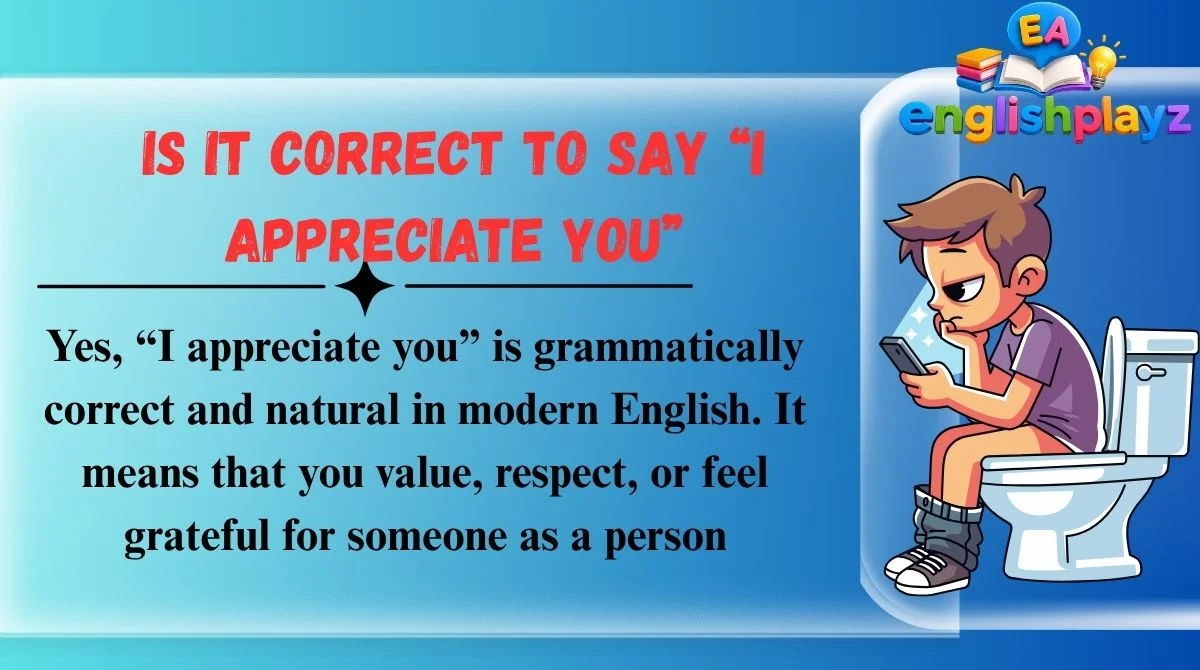
Is It Correct to Say “I Appreciate You”?
Yes, “I appreciate you” is grammatically correct and natural in modern English. It means that you value, respect, or feel grateful for someone as a person. Native speakers commonly use it in personal conversations, supportive messages, relationships, and workplace situations where recognition and gratitude are important.
The phrase is warm and sincere, but its suitability depends on context. It is often more personal than “thank you” because it expresses appreciation for the individual, not just something they did.
What Does “I Appreciate You” Mean?
The expression “I appreciate you” means “I value you,” “I am grateful for you,” or “I recognize the positive qualities you bring.” It communicates that someone’s presence, effort, support, kindness, or character matters.
The phrase is different from “I appreciate it.” When someone says “I appreciate it,” they are usually referring to a specific action, favor, or object.
For example:
- “Thank you for helping me move. I appreciate it.”
- The speaker is grateful for the help.
- “Thank you for always supporting me. I appreciate you.”
- The speaker is expressing gratitude toward the person themselves.
The phrase can carry different meanings depending on the relationship:
- In a friendship, it may mean “I value our friendship.”
- In a workplace, it may mean “I recognize your effort and contribution.”
- In a relationship, it may mean “I cherish and value you.”
- In a family context, it may mean “I am grateful for everything you do.”
Examples:
- “I appreciate you always checking in when things are difficult.”
- “I appreciate you for being honest with me.”
- “I appreciate you more than you know.”
The expression is often used when someone wants to acknowledge something deeper than a single favor.
Why Is “I Appreciate You” Grammatically Correct?
The grammar of “I appreciate you” follows a standard English structure:
Subject + verb + object
- Subject: I
- Verb: appreciate
- Object: you
The verb appreciate can take a person as its object. Many learners know it from sentences such as:
- “I appreciate your help.”
- “I appreciate your advice.”
- “I appreciate your kindness.”
However, it can also be used directly with a person:
- “I appreciate you.”
Here, “you” is the object being appreciated.
Some learners assume the phrase should be “I appreciate of you” or “I appreciate about you,” but those structures are incorrect. The verb does not require those extra words.
Correct:
- “I appreciate you.”
- “I appreciate your support.”
- “I appreciate what you did.”
Incorrect:
- “I appreciate of you.”
- “I appreciate about you.”
The grammar is simple, but the emotional meaning is what makes the phrase feel different from other expressions of gratitude.
How Natural Does “I Appreciate You” Sound to Native Speakers?
“I Appreciate You” is natural English, but its frequency and impact depend on the speaker and situation. Native speakers understand it immediately, and many use it regularly when they want to express genuine gratitude or recognition.
However, it is not always the first phrase people choose in everyday conversation. In many situations, speakers are more likely to say:
- “Thank you.”
- “I really appreciate it.”
- “I appreciate your help.”
- “I’m grateful for you.”
The phrase “I appreciate you” often feels more intentional and personal.
For example:
Natural and warm:
“I just wanted to say I appreciate you. You have been incredibly supportive.”
Possible but less personal:
“I appreciate you sending the document.”
In the second example, “I appreciate you sending the document” is grammatically correct, but “I appreciate you sending…” focuses on the action. Many speakers would naturally say:
“I appreciate you sending the document.”
or
“I appreciate you taking the time to send the document.”
The phrase becomes especially natural when the speaker is recognizing a person’s ongoing qualities, effort, or character.
Is “I Appreciate You” Polite, Professional, or Too Personal?
“I appreciate you” can be polite and professional, but it carries warmth. Whether it fits depends on the workplace culture and your relationship with the person.
In professional communication, it works well when expressing recognition:
Example:
“I appreciate you taking the lead on this project and helping the team meet the deadline.”
This sounds respectful and encouraging.
It may be less suitable in very formal situations where a more specific statement is expected:
Less suitable:
“Dear Professor, I appreciate you.”
More suitable:
“Dear Professor, I appreciate your guidance and support throughout this course.”
The reason is that professional communication often benefits from explaining what you appreciate.
Good workplace examples:
- “I appreciate you sharing your expertise with the team.”
- “I appreciate you staying late to help us complete the report.”
- “I appreciate you handling this situation with professionalism.”
In emails, adding a specific reason often makes the phrase stronger and more natural.
When Should You Use “I Appreciate You”?
“I Appreciate You” is most effective when you want to recognize someone’s value rather than simply thank them for a single action.
Good situations include:
Personal relationships
Friends, family members, and partners often use this phrase to express emotional appreciation.
Example:
“I appreciate you being there for me during a difficult time.”
Supportive conversations
It can encourage someone who has helped or cared for others.
Example:
“I know things have been stressful lately, but I want you to know I appreciate you.”
Workplace recognition
Managers and colleagues can use it to acknowledge effort.
Example:
“I appreciate you always bringing thoughtful ideas to our meetings.”
Messages and cards
The phrase works well in personal notes because it sounds sincere.
Example:
“I appreciate you more than words can explain. Thank you for everything you do.”
The key is that the phrase usually highlights the person, not just the task.
When Might “I Appreciate You” Sound Awkward?
Although correct, “I appreciate you” can sound unusual if the context does not match its personal tone.
For example, saying:
“I appreciate you giving me the receipt.”
is understandable, but many speakers would prefer:
“I appreciate you giving me the receipt.”
or simply:
“Thank you for giving me the receipt.”
The phrase may also feel too emotionally strong in a brief professional exchange.
Awkward example:
“Customer service representative, I appreciate you.”
This is not wrong, but it may sound overly personal because the speaker probably wants to thank the service provided rather than express personal appreciation for the individual.
Better:
“I appreciate your help today.”
Other situations where another phrase may work better:
- A quick transaction
- A formal business letter
- A first interaction with someone
- Situations where the specific action matters more than the person
Examples:
- Instead of “I appreciate you answering my question,” say “I appreciate your quick response.”
- Instead of “I appreciate you for the information,” say “I appreciate the information you provided.”
“I Appreciate You” vs. Similar Expressions
Several expressions can communicate gratitude, but their meanings and emotional levels differ.
| Expression | Meaning | Tone | Best use |
|---|---|---|---|
| I appreciate you | I value you as a person | Warm and personal | Relationships, recognition, supportive communication |
| I appreciate it | I am thankful for an action | Neutral | Everyday favors |
| I appreciate your help | I am thankful for your assistance | Polite and professional | Workplaces and formal situations |
| Thank you | I am grateful | General | Almost any situation |
| I’m grateful for you | I deeply value you | Very warm | Close relationships |
Examples:
- “Thank you for your advice.”
- Simple and polite.
- “I appreciate your advice.”
- Shows recognition and respect.
- “I appreciate you.”
- Focuses on the person who gave the advice.
Another similar phrase is “I value you.” This is correct but can sound slightly more serious or emotional.
Example:
“I value you as a colleague and appreciate everything you contribute.”
How to Use “I Appreciate You” in Emails and Messages
In written communication, “I appreciate you” is usually strongest when followed by an explanation. A short phrase alone can sometimes feel incomplete.
Less effective:
“I appreciate you.”
Better:
“I appreciate you always making time to help the team.”
Professional email examples:
- “I appreciate you taking the time to review my proposal.”
- “I appreciate you sharing your feedback before the meeting.”
- “I appreciate you supporting this project from the beginning.”
Personal message examples:
- “I appreciate you always listening when I need someone to talk to.”
- “I appreciate you being such a reliable friend.”
The phrase works particularly well in messages because writing allows people to add personal details that clarify the meaning.
Common Mistakes When Using “I Appreciate You”
Even though the phrase is correct, learners sometimes use it in ways that sound unnatural.
Mistake 1: Using “appreciate” with unnecessary words
Incorrect:
“I appreciate about you.”
Correct:
“I appreciate you.”
or:
“I appreciate your kindness.”
Mistake 2: Confusing a person with an action
“I appreciate you” and “I appreciate what you did” are related but not identical.
Compare:
“I appreciate you.”
Meaning: I value you.
“I appreciate what you did.”
Meaning: I am thankful for your action.
Mistake 3: Using it in every thank-you situation
The phrase is meaningful, but it should not replace every “thank you.”
For example:
At a coffee shop:
“Thank you for the coffee.”
sounds more natural than:
“I appreciate you.”
Mistake 4: Making it sound too formal
Some learners use “I appreciate you” because they believe it is a more advanced version of “thank you.” It is not simply a formal replacement. It has a different emotional focus.
Do Americans and British Speakers Use “I Appreciate You” Differently?
“I Appreciate You” is understood in both American and British English. The phrase is not incorrect in either variety.
In American English, the expression is especially common in personal encouragement, workplace recognition, and messages expressing gratitude.
Examples:
- “I appreciate you always having my back.”
- “I appreciate you stepping up when we needed help.”
British English speakers also use the phrase, although depending on the individual and context, they may sometimes prefer more specific wording:
- “I really appreciate your help.”
- “I’m very grateful for your support.”
These are not strict regional rules. Personal style, workplace culture, and relationship matter more than nationality.
The important point is that English speakers in different regions will understand “I appreciate you,” but some may choose a more specific expression depending on the situation.
FAQs
Is it correct to say “I appreciate you”?
Yes, “I appreciate you” is grammatically correct and natural English. It expresses gratitude, respect, or recognition toward a person. It is often used when someone wants to show that they value another person, not just a specific action.
What does “I appreciate you” mean?
“I appreciate you” means “I value you,” “I am grateful for you,” or “I recognize what you bring to my life.” The exact meaning depends on context. It can express friendship, professional respect, emotional support, or admiration.
Is “I appreciate you” more personal than “thank you”?
Yes. “Thank you” can be used for almost any situation, while “I appreciate you” usually feels more personal. It focuses on the person rather than only the favor, action, or object involved.
Is “I appreciate you” professional?
Yes, it can be professional when used appropriately. In workplaces, it often sounds best when connected to a specific contribution, such as “I appreciate you taking the initiative on this project.”
Can I use “I appreciate you” in an email?
Yes, but adding details usually makes it sound more natural. Instead of writing only “I appreciate you,” consider writing “I appreciate you taking the time to review this document” or “I appreciate your continued support.”
What is a better alternative to “I appreciate you”?
The best alternative depends on the situation. “I appreciate your help” is more professional, “I appreciate it” is more casual and action-focused, and “I’m grateful for you” is more emotional and personal.
Final Thoughts:
The answer to “is it correct to say i appreciate you” is yes. The phrase is grammatically correct, natural, and widely understood in modern English.
It communicates something deeper than a simple “thank you” because it recognizes the person rather than only their action.
“I appreciate you” works especially well in personal conversations, supportive messages, workplace recognition, and situations where you want someone to feel valued.
However, it may sound overly personal in some formal situations, so a more specific phrase like “I appreciate your help” or “I appreciate your support” may be better.
The best choice depends on your relationship with the listener and what you want to express.
Use “I appreciate you” when you want to acknowledge someone’s importance, effort, or character. Use more specific gratitude phrases when you want to highlight a particular action or contribution.

I am Sayan Roy, an English language enthusiast dedicated to helping readers understand word meanings, vocabulary, grammar, and useful English expressions through clear, simple, and informative content.