Many English speakers wonder, “is it correct to say as per?” because the phrase appears frequently in business emails, official documents, and workplace conversations, yet it can sometimes sound overly formal or unusual.
The short answer is yes: “as per” is grammatically correct, but its naturalness depends heavily on context, audience, and tone.
The expression means “according to” or “in accordance with,” and it is commonly used when referring to instructions, rules, agreements, requests, or information from another source.
However, in everyday conversation, many native speakers prefer simpler alternatives such as “according to,” “based on,” or “following.”
This article explains what “as per” means, whether it sounds professional or polite, where it works best, when it may feel awkward, and how to choose a more natural alternative when needed.
Is It Correct to Say “As Per”?
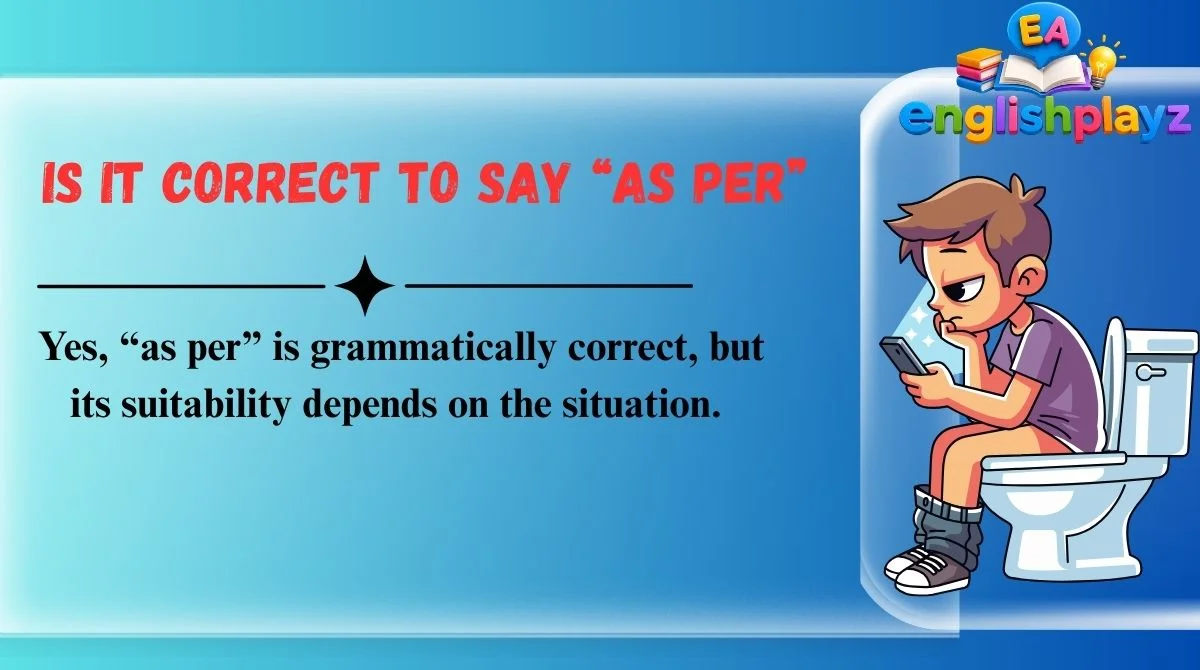
Yes, “as per” is grammatically correct, but its suitability depends on the situation. It means “according to” or “following,” and it is commonly used in formal writing, business communication, instructions, and official contexts. While it is acceptable, it can sound more formal or bureaucratic than everyday alternatives like “according to” or “as requested.”
What Does “As Per” Mean in English?
The phrase “as per” means “according to,” “in agreement with,” or “following something that has been stated, decided, requested, or established.”
The word “as” indicates a relationship with something else, while “per” means “in accordance with” or “according to.” Together, they create a phrase used to show that an action, statement, or decision follows a particular source or instruction.
For example:
- “As per the company policy, employees must submit the form by Friday.”
- “As per your request, I have attached the updated document.”
In both sentences, the speaker is saying that the action follows a specific rule or request.
The phrase often appears when the writer wants to connect information to an authority, document, instruction, or previous communication.
Common meanings include:
- According to a rule or policy
- Following someone’s request
- Based on an agreement or decision
- In line with instructions
- In accordance with a stated condition
Although “as per” has the same basic meaning as “according to,” the tone is usually more formal.
Is “As Per” Grammatically Correct?
Yes, “as per” is grammatically correct in standard English. It functions as a prepositional phrase and is followed by a noun phrase.
The basic structure is:
As per + noun/pronoun phrase
Examples:
- “As per the agreement, payment will be made within 30 days.”
- “As per your email, we have updated the schedule.”
- “As per the instructions provided, please complete the application.”
The phrase cannot normally stand alone. It needs something that explains what the information is based on.
Correct:
- “As per the manager’s instructions, the team changed the deadline.”
Incorrect:
- “As per, the team changed the deadline.”
The second example is incomplete because “as per” requires a reference point.
A common misconception is that “as per” is incorrect because it sounds formal or because some speakers prefer not to use it. However, a phrase being less common in casual conversation does not make it grammatically wrong.
How Natural Does “As Per” Sound to Native English Speakers?
The naturalness of “as per” depends on the setting.
In professional and official writing, many English speakers find it perfectly acceptable. It is especially common in:
- Business correspondence
- Legal documents
- Contracts
- Policies
- Administrative communication
- Instructions and procedures
Examples:
“As per our discussion yesterday, we will proceed with the revised plan.”
This sounds professional and appropriate.
However, in relaxed conversations, “as per” can sound stiff or unnecessarily formal.
A native speaker would usually say:
- “According to John, the meeting starts at three.”
- “As John mentioned, the meeting starts at three.”
rather than:
- “As per John, the meeting starts at three.”
The last sentence is understandable, but it sounds unnatural in casual speech.
The key distinction is:
- Correct grammar: Yes.
- Always natural: No.
- Best for every situation: No.
Is “As Per” Formal, Polite, or Professional?
“As per” is generally considered formal and professional, especially in written communication.
It often creates a tone that is:
- Official
- Neutral
- Administrative
- Precise
- Businesslike
For example, in a workplace email:
“As per your instructions, I have completed the report.”
This sounds polite and professional because it acknowledges someone’s request.
However, “as per” does not automatically make a sentence more polite. It mainly changes the level of formality.
Compare:
Formal:
“As per your request, the changes have been implemented.”
More natural and equally polite:
“As requested, the changes have been implemented.”
The second version may feel smoother because it avoids unnecessary formality.
When Should You Use “As Per” in Workplace Communication?
“As per” is especially useful when you need to refer to a specific instruction, policy, agreement, or previous message.
Good workplace examples include:
- Following instructions
“As per your instructions, I have revised the presentation.”
- Following company rules
“As per company policy, all expenses must be approved before payment.”
- Referring to previous discussions
“As per our conversation, the delivery date has been moved to Monday.”
- Confirming agreed decisions
“As per the agreement, both parties will review the contract annually.”
In these situations, “as per” helps make the connection between the action and the source clear.
It is particularly common in emails where employees need to document decisions or instructions.
Example email sentence:
“As per our meeting yesterday, I have attached the final version of the proposal for your review.”
This sounds appropriate in a professional environment.
Is “As Per” Suitable for Emails and Written Messages?
Yes, “as per” can be suitable for emails, but the best choice depends on the relationship between the writer and reader.
Professional emails
In formal workplace emails, “as per” is often acceptable.
Example:
“As per the client’s requirements, we have updated the design specifications.”
This is clear and professional.
Emails to colleagues
With coworkers you know well, simpler wording may sound more natural.
Instead of:
“As per your message, I will complete the task today.”
You might write:
“Based on your message, I will complete the task today.”
or:
“As you mentioned, I will complete the task today.”
Customer communication
When writing to customers, clarity is often more important than formality.
Example:
Less natural:
“As per your query, please find the details below.”
Better:
“Regarding your question, please find the details below.”
or:
“As requested, I have included the information below.”
Common Situations Where “As Per” Works Well
“As per” is appropriate when there is a clear reference point.
Referring to rules or policies
“As per the safety guidelines, protective equipment must be worn.”
Referring to instructions
“As per the doctor’s advice, he should avoid strenuous activity.”
Referring to agreements
“As per the contract terms, the payment is due next month.”
Referring to requests
“As per your request, I have forwarded the documents.”
Referring to schedules or plans
“As per the updated timetable, the class will begin at 10 a.m.”
In each example, the phrase introduces information that comes from another source.
When Should You Avoid Using “As Per”?
Although correct, “as per” is not always the best choice.
You should avoid it when:
1. The situation is casual
In everyday conversation, it may sound too formal.
Less natural:
“As per my friend, that restaurant is excellent.”
More natural:
“According to my friend, that restaurant is excellent.”
2. A simpler phrase sounds clearer
Sometimes “as per” adds formality without adding meaning.
Less natural:
“As per the information available, the event was canceled.”
Better:
“According to the available information, the event was canceled.”
3. The sentence is already complicated
Using formal phrases repeatedly can make writing feel distant.
Example:
“As per the aforementioned instructions, please proceed as per the previously discussed procedure.”
This sounds unnecessarily bureaucratic.
A clearer version:
“Please follow the procedure we discussed earlier.”
4. You are writing for a general audience
Plain English is usually better for customers, students, and public communication.
Better Alternatives to “As Per” and Their Differences
Although “as per” is correct, other expressions may sound more natural depending on the context.
| Alternative | Meaning | Best used when |
|---|---|---|
| According to | Based on information from a source | General communication |
| As requested | Following someone’s request | Emails and professional replies |
| Based on | Using information or evidence | Reports and explanations |
| Following | After or because of instructions | Procedures and actions |
| In accordance with | Following rules or standards | Formal documents |
| As stated by | Referring directly to someone’s words | Reports and explanations |
“According to”
This is the most common general alternative.
Example:
“According to the report, sales increased this quarter.”
It works in both formal and informal situations.
“As requested”
This is often better when responding to someone.
Instead of:
“As per your request, I have attached the file.”
You can write:
“As requested, I have attached the file.”
This sounds natural and professional.
“Based on”
Use this when something depends on evidence or information.
Example:
“Based on customer feedback, we changed the design.”
“In accordance with”
This is more formal than “as per.”
Example:
“The company operates in accordance with international standards.”
It is common in legal and official writing.
Common Mistakes When Using “As Per”
Many mistakes happen because people use “as per” too frequently or combine it with unnecessary words.
Mistake 1: Using “as per” in casual speech
Incorrect or awkward:
“As per my brother, this movie is amazing.”
Better:
“According to my brother, this movie is amazing.”
Mistake 2: Saying “as per of”
Incorrect:
“As per of the instructions…”
Correct:
“As per the instructions…”
“As per” does not use “of” afterward.
Mistake 3: Repeating “as per” too often
Example:
“As per the email, and as per the policy, and as per the manager’s instructions…”
This feels repetitive.
Use alternatives:
“According to the email and company policy, the process must be followed.”
Mistake 4: Using it without a reference
Incorrect:
“As per, we completed the work.”
Correct:
“As per the agreement, we completed the work.”
Regional Differences: American and British English Usage
“As per” is understood in both American and British English, but its frequency and style vary.
In many professional environments in the United States and the United Kingdom, the phrase is accepted, especially in formal documents and business writing.
However, everyday speakers in both regions often prefer:
- “According to”
- “As requested”
- “Based on”
- “Following”
The phrase may be especially noticeable in international business English because it is widely used in formal workplace communication around the world.
For native speakers, “as per” is usually not confusing. The main issue is not correctness but tone. It can sometimes sound more official than necessary.
FAQs
Is “as per” grammatically correct in English?
Yes, “as per” is grammatically correct. It is a prepositional phrase meaning “according to” or “in accordance with.” It should be followed by a noun phrase, such as “as per the instructions” or “as per your request.”
Is “as per” professional to use in emails?
Yes, “as per” can be professional in emails, especially when referring to instructions, policies, agreements, or previous discussions. However, simpler alternatives like “as requested” or “according to” may sound more natural in many workplace messages.
Is “as per” polite?
“As per” is neutral rather than specifically polite. It can sound professional because it acknowledges a source or instruction, but politeness mainly comes from the overall wording and tone of the message.
Can you say “as per your request”?
Yes, “as per your request” is grammatically correct and commonly used. However, “as requested” is often shorter and more natural, especially in modern professional writing.
Is “as per” the same as “according to”?
They have very similar meanings, but their tones differ. “According to” is more common and versatile, while “as per” sounds more formal and administrative.
Should I use “as per” in everyday conversation?
You can, but it may sound overly formal in casual speech. Most native speakers would usually choose “according to,” “like,” or “as someone mentioned” in everyday conversations.
Final Thoughts
The answer to “is it correct to say as per?” is yes. The phrase is grammatically correct and widely understood in modern English. It means “according to” or “following,” and it works well in formal writing, workplace communication, policies, agreements, and official messages.
However, correctness does not always equal naturalness. In casual conversations and many everyday situations, “as per” can sound more formal than necessary.
Native speakers often prefer simpler alternatives such as “according to,” “as requested,” or “based on.”
The best choice depends on your audience and purpose. Use “as per” when you need a professional or official tone, especially when referring to instructions or documents.
For general communication, a simpler phrase may make your writing sound clearer, warmer, and more natural.

I am Sayan Roy, an English language enthusiast dedicated to helping readers understand word meanings, vocabulary, grammar, and useful English expressions through clear, simple, and informative content.